
UBIQUITI NETWORKS AM-V2G-Ti
Networks > Wireless Networking > Access Points
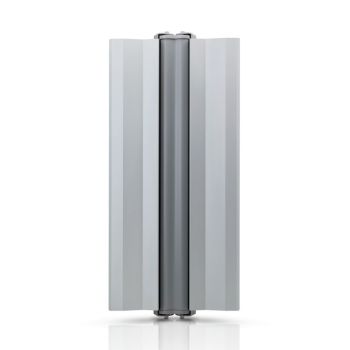
UBIQUITI NETWORKS AM-V2G-Ti
| Lieske Part No. | 263682 |
|---|---|
| Mfg Part No | AM-V2G-Ti |
| EAN-Code | 0810354021008 |
| Manufacturer | UBIQUITI NETWORKS |
| Here only | 223,04 EUR
265,42 EUR incl. VAT
|
Further information for UBIQUITI NETWORKS AM-V2G-Ti
| General | |
| Frequency | 2,3-2,6 GHz |
| Beam width angle | 60°/ 90°/ 120° |
| Gain | 17 dBi at 60°, 16 dBi at 90°, 15 dBi at 120° |
| Electrical downward slope | 4° |
| Wind survival capability | 200 km/h |
| Wind load | 640,5 N |
| Polarization | Dual-Linear |
| Cross-polarisation isolation | 25 dB typical |
| F/B ratio | 30 dB typical |
| Max. VSWR | 1,5:1 |
| RF connectors | 2 RP-SMA connectors (weatherproof) |
| Compatible radios | RocketM2 Titan, RocketM2 |
| Mounting | Mast mounting (kit included in delivery scope) |
| ETSI specification | EN 302 326 DN2 |
| Certifications | CE, FCC, IC |
Applications
The antenna is suitable for use in wireless networks, particularly in base stations, where targeted coverage with variable beamwidth is required. It is designed for outdoor use, such as in industrial environments, building coverage, or rural areas, where a stable and long-range wireless connection is needed. The wind survival capability of 200 km/h and the high wind load of 640.5 N at this speed make it suitable for exposed locations.
Functions and Features in Detail
The AM-V2G-Ti offers an adjustable beamwidth configuration with three preset angles: 60°, 90°, and 120°. Depending on the selected beamwidth, the gain varies: 17 dBi at 60°, 16 dBi at 90°, and 15 dBi at 120°. This adjustment allows for targeted coverage, where a narrower beamwidth provides greater range and a wider beamwidth offers larger coverage area. The antenna features an electrical downtilt of 4°, which supports optimal alignment with target positions. The dual-linear polarisation with a typical cross-pol isolation of 25 dB ensures efficient signal transmission and minimises interference.
Technology Explained Simply
The antenna operates in the frequency range of 2.3 to 2.6 GHz, which corresponds to the 2.4-GHz band and is commonly used for wireless communication in WLAN and radio networks. The gain in dBi describes the focusing of the signal in a specific direction – the higher the value, the more focused and longer-range the signal. The maximum VSWR (Voltage Standing Wave Ratio) of 1.5:1 indicates good impedance matching, which ensures efficient energy transfer and low reflections. The RF connectors consist of two RP-SMA connectors, which are weatherproof, ensuring a reliable connection even under adverse weather conditions.
Compatibility and Accessories
The antenna is compatible with RocketM2 Titan and RocketM2 modules. Installation is done via a mast mount, which is included in the delivery. The antenna is designed for outdoor use and complies with the ETSI specification EN 302 326 DN2. Certifications CE, FCC, and IC confirm compliance with applicable standards in Europe, the USA, and Canada.
Installation and Mounting
Mounting is done on a mast using the included mast mount. The antenna is designed for fixed mounting and requires secure fastening to withstand the wind load of 640.5 N at 200 km/h. The electrical downtilt of 4° supports correct alignment to ensure optimal signal coverage. The RP-SMA connectors allow direct connection to compatible radio modules.
Operational Advantages
The individual configurability of the beamwidth enables customised network alignment, allowing coverage to be optimally adapted to the specific environment. The high RF isolation and typical F/B ratio of 30 dB ensure clear signal transmission with minimal interference. The robust construction and weatherproof connectors make the antenna suitable for long-term outdoor use. Compatibility with Rocket M2 modules enables easy integration into existing Ubiquiti networks.

This is an offer of:
79279 Vörstetten
https://industry-electronics.com
Tel. 07666/88499-0
Fax. 07666/88499-111
Diesen Artikel finden Sie unter:
industry-electronics.com/artikel/263682

Lieske Elektronik e.K.
Reutener Str. 1079279 Vörstetten
https://industry-electronics.com
Tel. 07666/88499-0
Fax. 07666/88499-111
Diesen Artikel finden Sie unter:
industry-electronics.com/artikel/263682