
TP-Link TL-SM321A-2 Fiber Converter SFP/Bi-Di/LC
Networks > Switches > Modules
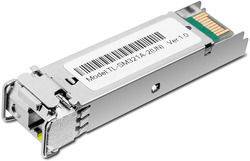
TP-Link TL-SM321A-2 Fiber Converter SFP/Bi-Di/LC
| Lieske Part No. | 1606105 |
|---|---|
| Mfg Part No | TL-SM321A-2 |
| EAN-Code | 6935364072933 |
| Manufacturer | TP-Link |
| Here only | 13,93 EUR
16,58 EUR incl. VAT
|
Further information for TP-Link TL-SM321A-2 Fiber Converter SFP/Bi-Di/LC
| Certificates | |
| Compliance certificates | RoHS |
| Certification | CE, FCC |
| Features | |
| Product colour | Metallic |
| Hot-swap | |
| Logistics data | |
| Harmonized System (HS) code | 85369010 |
| Operational conditions | |
| Operating temperature (T-T) | 0 - 70 °C |
| Storage temperature (T-T) | -40 - 80 °C |
| Operating relative humidity (H-H) | 10 - 90% |
| Storage relative humidity (H-H) | 5 - 90% |
| Packaging content | |
| Quantity per pack | 1 pc(s) |
| Packaging data | |
| Package width | 81.5 mm |
| Package depth | 122.5 mm |
| Package height | 38.5 mm |
| Package weight | 60 g |
| Performance | |
| SFP transceiver type | Fiber optic |
| Maximum data transfer rate | 1250 Mbit/s |
| Interface type | SFP |
| Fiber optic connector | LC (UPC) |
| Fiber cable diameters supported (core/cladding) | 9/125 µm |
| SFP transceiver standard | BX |
| Maximum transfer distance | 1000 m |
| Tx wavelength (max) | 1550 nm |
| Rx wavelength (max) | 1310 nm |
| Networking standards | IEEE 802.3z |
| Fiber ethernet cabling technology | 1000BASE |
| Single-mode fiber (SMF) supported | |
| Multi-mode fiber (MMF) supported | |
| Wavelength-division multiplexing (WDM) | |
| Power | |
| Input voltage | 3.3 V |
Applications
This module is used in network infrastructures where high bandwidth and stability over fibre optic links are required. Typical applications include connecting network devices in enterprise networks, where data transmission over longer distances (up to 2 km) occurs over a single fibre cable. Bidirectional transmission is achieved by using different wavelengths: the transmit wavelength (Tx) is up to 1550 nm, and the receive wavelength (Rx) is up to 1310 nm. This technology enables efficient use of fibre infrastructure, as only one fibre strand is required.
Functions and Features in Detail
The module supports Digital Diagnostic Monitoring (DDM), enabling real-time monitoring of operational parameters. These include measurement of operating temperature, power supply, optical transmit power (Tx), and receive power (Rx). This function is particularly useful for network administration, as it provides early warnings of deviations or faults. Additionally, the module is hot-swappable, meaning it can be replaced without interrupting network operation. Power supply is via 3.3 V, which is standard for SFP modules.
Technology Explained Simply
The WDM principle (wavelength division multiplexing) allows simultaneous data transmission in both directions over a single fibre by using different light wavelengths for transmission and reception. The 1000Base-BX standard is specified for this purpose and is supported by this module. The LC connector is a common, compact fibre optic connector suitable for use in modern networks. The single-mode fibre (SMF) with 9/12ed µm is designed for long distances and high data rates, as it supports only one light mode and thus exhibits lower attenuation losses.
Compatibility and Accessories
The module is compatible with the SFP Multi-Source Agreement (SFP-MSA), ensuring standardisation of physical and electrical interfaces. This makes it usable with a wide range of network devices from various manufacturers, provided they support SFP slots. It is specifically designed for use in single-mode fibre networks and does not support multi-mode fibre (MMF). Use with other SFP modules, particularly the TL-SM321B-2, is common in bidirectional connections, where the wavelengths of the two modules are complementary.
Installation and Mounting
Installation is performed by simply inserting the module into an SFP slot of a compatible network device. Due to the hot-swap feature, this can be done during operation without interrupting network service. Connection to the fibre cable is made via the integrated LC connector. Physical mounting requires no additional tools or special preparations.
Operational Advantages
The module provides reliable and stable data transmission over fibre optic links at high speed. The DDM function enables proactive network monitoring, simplifying maintenance and troubleshooting. The hot-swap capability reduces downtime during replacement or maintenance. Compatibility with the SFP-MSA standard ensures broad usability in existing network infrastructures. The operating temperature range of 0 to 70 °C and storage temperature range of -40 to 80 °C make the module suitable for a wide range of environments, including industrial or outdoor installations. Relative humidity during operation is 10 to 90 %, non-condensing.
The module is available in a metallic-silver housing finish and is delivered in individual packaging. Packaging dimensions are 81.5 mm (width) × 122.5 mm (depth) × 38.5 mm (height), and the package weight is 60 g. Certifications CE and FCC, along with RoHS compliance, confirm adherence to relevant safety and environmental standards.

This is an offer of:
79279 Vörstetten
https://industry-electronics.com
Tel. 07666/88499-0
Fax. 07666/88499-111
Diesen Artikel finden Sie unter:
industry-electronics.com/artikel/1606105

Lieske Elektronik e.K.
Reutener Str. 1079279 Vörstetten
https://industry-electronics.com
Tel. 07666/88499-0
Fax. 07666/88499-111
Diesen Artikel finden Sie unter:
industry-electronics.com/artikel/1606105