
Softing IT Networks CT5015
Measurement > Cable Testers
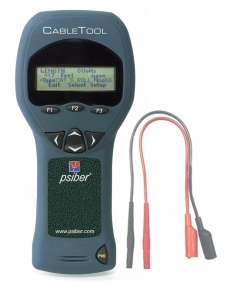
Softing IT Networks CT5015
| Lieske Part No. | 256111 |
|---|---|
| Mfg Part No | CT5015 |
| EAN-Code | 0046382253542 |
| Manufacturer | Softing IT Networks |
| Here only | 319,28 EUR
379,94 EUR incl. VAT
|
Further information for Softing IT Networks CT5015
| General | |
| TDR measurement range | 700 m |
Applications
The CableTool is used in electrical and IT installations to quickly and accurately identify cable faults. It is suitable for use in buildings, network infrastructure, telecommunications, as well as for the maintenance and repair of cable systems. The versatility of the device allows testing of different cable types, regardless of whether they are data transmission cables, power lines, or antenna systems.
Functions and Equipment in Detail
A central feature of the CableTool is the integrated, full-featured copper reflectometer (TDR), which can measure cable lengths up to 700 metres. Using this technology, the distance to the fault location is determined, for example, in cases of cable crushing, breaks, or short circuits. The TDR function thus enables targeted localisation of faults along the cable run, without the need to disconnect or visually expose the entire cable system.
In addition, the device features an integrated voltmeter function that measures voltages up to 250 volts. This function is used to determine whether a line is active and carrying voltage. The device can be directly connected to power cables, thereby reducing the risk of misinterpretation due to unintended power supply.
Technology Explained Simply
The TDR (Time Domain Reflectometry) works by transmitting a short electrical pulse into the cable. When a fault occurs, such as a break or short circuit, part of the pulse is reflected. The device measures the time it takes for the reflected signal to return and calculates the distance to the fault location. This method is particularly useful when the exact position of a fault along the cable run is not visible.
The cable tracing function sends a signal into the cable, which propagates along the line. By emitting the signal, the cable path within walls or cable ducts can be tracked using an optional receiver, the CableTracker Probe. This facilitates the identification of cables in complex installations.
Compatibility and Accessories
The device is designed for all types of copper cables, including power cables, antenna cables, and network cables. The cable tracing function requires the use of an optional receiver, the CableTracker Probe, to visually track the cable path.
Mounting and Installation
The CableTool is directly connected to the cable to be tested. It requires no additional mounting or installation at the test site. Operation is performed via an integrated user interface that displays the measurement values. The application is typically carried out by specialists who interpret the measurement results and, if necessary, take corrective actions to resolve the fault.
Advantages in Operation
By combining TDR, voltmeter, and cable tracing functions in a single device, the CableTool offers comprehensive diagnostic capabilities. This reduces the number of required measurement instruments and accelerates fault localisation. The ability to measure voltages up to 250 V enables safe and reliable testing even in electrically powered installations. The maximum measurement length of 700 metres makes the device suitable for use in large buildings or industrial facilities.
Note: Batteries are not included in the delivery scope.

This is an offer of:
79279 Vörstetten
https://industry-electronics.com
Tel. 07666/88499-0
Fax. 07666/88499-111
Diesen Artikel finden Sie unter:
industry-electronics.com/artikel/256111

Lieske Elektronik e.K.
Reutener Str. 1079279 Vörstetten
https://industry-electronics.com
Tel. 07666/88499-0
Fax. 07666/88499-111
Diesen Artikel finden Sie unter:
industry-electronics.com/artikel/256111