
PSIB 228012 RJ45 Permanent Link test cable Cat. 6A
Measurement > Network Analyzers
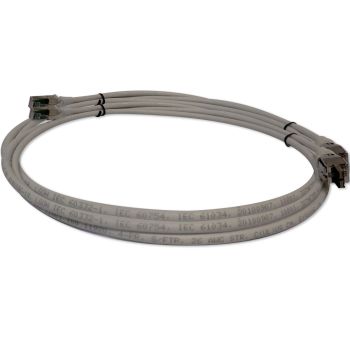
PSIB 228012 RJ45 Permanent Link test cable Cat. 6A
| Lieske Part No. | 1002755 |
|---|---|
| Mfg Part No | 228012 |
| EAN-Code | 0610098411055 |
| Manufacturer | Softing IT Networks |
| Here only | 161,50 EUR
192,19 EUR incl. VAT
|
Further information for PSIB 228012 RJ45 Permanent Link test cable Cat. 6A
| General | |
| Plug connection | RJ45 |
Permanent-Link-Test is a standardised method for evaluating the performance of a network cable connection, where the cable between two devices is measured, including the connectors (e.g. RJ45 plugs) as part of the measurement. The test cable WX_AC_6ALCORD2 is specifically designed for this purpose, to meet the required electrical and mechanical properties necessary for accurate measurement. It provides a reproducible and reliable measurement basis, making the results independent of the specific installation unit.
Category 6A (also Class EA) denotes a cable class with high bandwidth and low signal interference, suitable for Gigabit and 10-Gigabit Ethernet applications. The cable complies with the requirements of ISO/IEC 11801 and EN 50173-1 standards, which define the minimum performance requirements for structured cabling systems. The use of a cable of Class EA/Cat. 6A is particularly required in environments with high data rates and critical requirements for signal integrity, such as data centres, office buildings or industrial networks.
RJ45 connectors at both ends of the cable enable direct connection to standard network ports. The connectors are mechanically robust and designed for repeated connections, making them especially suitable for use in test environments. The connection is made via eight contacts, corresponding to the four pairs of the twisted-pair cabling, with the pairs twisted to minimise electromagnetic interference (EMI). The cable construction ensures that electrical properties such as impedance, attenuation and crosstalk remain within the specified limits.
Applications include the installation, maintenance and certification of network infrastructures. The cable is frequently used by installers, network technicians and quality inspectors to ensure that cabling meets the required technical specifications. It is particularly suitable for testing connections in cabling systems with high requirements for data transmission rate and signal quality. In practice, it is typically used in combination with a network test device that measures the electrical parameters of the cable and verifies compliance with standards.
Compatibility and accessories: The cable is designed for use with network test devices that support Permanent-Link measurements. It is not intended for use as a connection cable in an active network, but exclusively as a reference cable for measurement purposes. It is typically supplied as a single unit (1 pair), and sources do not mention any additional components or accessories. Use is in combination with suitable test devices that enable measurement of electrical parameters.
Installation and mounting are performed by simply plugging the RJ45 connectors into the corresponding sockets of the test devices or the cabling to be tested. No additional tools or mounting aids are required. The cable is designed for repeated use and can be used over a long period with proper handling. The mechanical stability of the connectors ensures a secure connection during measurement.
Operational advantages lie in the reliability and reproducibility of measurement results. Since the cable is specifically developed for Permanent-Link tests, it minimises error sources that could arise from unspecific or non-calibrated cables. Compliance with Category 6A standards ensures that measurement results align with industry requirements. This is particularly important for the certification of network infrastructures, where compliance with standards must be demonstrated.

This is an offer of:
79279 Vörstetten
https://industry-electronics.com
Tel. 07666/88499-0
Fax. 07666/88499-111
Diesen Artikel finden Sie unter:
industry-electronics.com/artikel/1002755

Lieske Elektronik e.K.
Reutener Str. 1079279 Vörstetten
https://industry-electronics.com
Tel. 07666/88499-0
Fax. 07666/88499-111
Diesen Artikel finden Sie unter:
industry-electronics.com/artikel/1002755