
PSIB 226737 NX_XG2_1G NetXpert XG2 1 GBit/s
Measurement > Network Analyzers
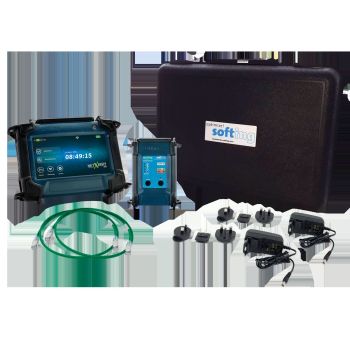
PSIB 226737 NX_XG2_1G NetXpert XG2 1 GBit/s
| Lieske Part No. | 1873311 |
|---|---|
| Mfg Part No | 226737 |
| EAN-Code | 0046382253993 |
| Manufacturer | Softing IT Networks |
| Here only | 2.337,50 EUR
2.781,63 EUR incl. VAT
|
Further information for PSIB 226737 NX_XG2_1G NetXpert XG2 1 GBit/s
| General | |
| Maximum data transfer rate | 1 Gbit/s |
Applications
The NetXpert XG2 is used in IT infrastructure installation and maintenance, particularly for testing copper cabling in LAN networks. It is suitable for qualifying cabling in office buildings, industrial facilities, data centres and other environments where reliable network connectivity is required. The functions support both planning and installation, as well as maintenance and troubleshooting in existing networks.
Functions and Equipment in Detail
The device displays the wiring map, determines cable length and distance to breaks or short circuits. It performs active network tests, including connection status checks, DHCP tests, Network-Discovery, Ping lists, Traceroute, VLAN detection, and support for IPv4 and IPv6. Additionally, it recognises CDP and LLDP protocols, which are used for identifying network components. PoE testing is performed up to 90 W, ensuring compatibility with modern PoE end devices. The integrated PDF report generation allows documentation of test results directly on the device.
Technology Explained Simply
The use of BERT (Bit Error Rate Test) enables measurement of the error rate during data transmission, quantifying the quality of the connection. SNR (signal-to-noise ratio) indicates how strong the useful signal is compared to noise, which is important for transmission stability. Delay Skew measures timing differences between individual conductors, which is critical at high transmission rates to avoid signal overlap. The combination of these methods ensures comprehensive cabling analysis.
Compatibility and Accessories
The device is designed for copper cabling and can optionally be extended with fibre optic modules. Compatibility with PoE end devices up to 90 W makes it suitable for testing network components such as access points or IP cameras. Integrated network detection via LLDP and CDP supports identification of switches, routers and other devices in the network.
Mounting and Installation
The device is operated as a handheld unit, with the main unit connected to a remote end unit to test the cabling. The delivery includes two RJ45 Cat 6A patch cables, used for connecting the main unit to the remote end unit and for connecting to the cabling under test. Installation requires no additional tools, as the cabling is connected directly to the RJ45 ports.
Operational Advantages
The integrated PDF report generation enables quick documentation of test results, which is important for traceability and quality control. The combination of passive and active tests provides comprehensive diagnosis, covering both physical cabling and network communication. Support for IPv4 and IPv6, as well as PoE tests up to 90 W, extends the application range to modern network environments. The user interface is designed for professionals in IT and electrical trades, with results readable and documentable directly on the device.

This is an offer of:
79279 Vörstetten
https://industry-electronics.com
Tel. 07666/88499-0
Fax. 07666/88499-111
Diesen Artikel finden Sie unter:
industry-electronics.com/artikel/1873311

Lieske Elektronik e.K.
Reutener Str. 1079279 Vörstetten
https://industry-electronics.com
Tel. 07666/88499-0
Fax. 07666/88499-111
Diesen Artikel finden Sie unter:
industry-electronics.com/artikel/1873311