
Schneider Electric ATS01N222QN Soft Starter 22 A
Industrial Material > Automation > Frequency converter, soft starter
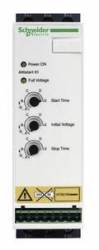
Schneider Electric ATS01N222QN Soft Starter 22 A
| Lieske Part No. | 307326 |
|---|---|
| Mfg Part No | ATS01N222QN |
| EAN-Code | 3389110667318 |
| Manufacturer | Schneider Electric |
| Here only | 382,85 EUR
455,59 EUR incl. VAT
|
Further information for Schneider Electric ATS01N222QN Soft Starter 22 A
| Complementary | |
| Assembly style | With heat sink |
| Function available | Integrated bypass |
| Supply voltage limits | 342…456 V |
| Supply frequency | 50...60 Hz - 5...5 % |
| Network frequency | 47.5...63 Hz |
| [Uc] Control circuit voltage | Built into the starter |
| Starting time | 1 s / 100; 5 s / 20; 10 s / 10; Adjustable from 1 to 10 s |
| Deceleration time symb | Adjustable from 1 to 10 s |
| Starting torque | 30...80 % of starting torque of motor connected directly on the line supply |
| Discrete input type | Logic (LI1, LI2, BOOST) stop, run and boost on start-up functions |
| Discrete input voltage | 24...40 V |
| Discrete input logic | Positive LI1, LI2, BOOST at State 0: < 5 V and 13 V, >= 0.5 mA |
| Discrete output current | 2 A DC-13; 3 A AC-15 |
| Discrete output type | Open collector logic LO1 end of starting signal; Relay outputs R1A, R1C NO |
| Discrete output voltage | 24 V (voltage limits: 6...30 V) open collector logic |
| Minimum switching current | 10 mA at 6 V DC for relay outputs |
| Maximum switching current | Relay outputs: 2 A at 250 V AC cos phi = 0.5 and L/R = 20 ms inductive load; Relay outputs: 2 A at 30 kV DC cos phi = 0.5 and L/R = 20 ms inductive load |
| Display type | 1 LED (green) for starter powered up; 1 LED (yellow) for nominal voltage reached |
| Tightening torque | 0.5 N.m; 1.9…2.5 N.m |
| Marking | CE |
| Operating position | Vertical +/- 10 degree |
| Height | 154 mm |
| Width | 45 mm |
| Depth | 131 mm |
| Net weight | 0.56 kg |
| Compatibility code | ATS01N2 |
| Power range | 7…11 kW at 380…440 V 3 phases |
| Motor starter type | Soft starter |
| Contractual warranty | |
| Warranty (in months) | 18 |
| Environment | |
| Standards | EN/IEC 60947-4-2 |
| Product certifications | CSA; UL; CCC; C-Tick; GOST |
| IP degree of protection | IP20 |
| Pollution degree | 2 conforming to EN/IEC 60947-4-2 |
| Vibration resistance | 1 gn (f= 13…150 Hz) conforming to EN/IEC 60068-2-6; 1.5 mm peak to peak (f= 3…13 Hz) conforming to EN/IEC 60068-2-6 |
| Shock resistance | 15 gn for 11 ms conforming to EN/IEC 60068-2-27 |
| Relative humidity | 5…95 % without condensation or dripping water conforming to EN/IEC 60068-2-3 |
| Ambient air temperature for operation | -10…40 °C (without derating); 40…50 °C (with current derating of 2 % per °C) |
| Ambient air temperature for storage | -25…70 °C conforming to EN/IEC 60947-4-2 |
| Operating altitude | 1000 m with current derating of 2.2 % per additional 100 m |
| Logistical informations | |
| Country of origin | DE |
| Main | |
| Range of product | Altistart 01 |
| Product destination | Asynchronous motors |
| Product or component type | Soft starter |
| Product specific application | Simple machine |
| Device short name | ATS01 |
| Network number of phases | 3 phases |
| [Us] rated supply voltage | 380...415 V - 10...10 % |
| Motor power kW | 11 kW, 3 phases at 380...415 V; 7.5 kW, 3 phases at 380...415 V |
| IcL starter rating | 22 A |
| Utilisation category | AC-53B conforming to EN/IEC 60947-4-2 |
| Current consumption | 110 A at nominal load |
| Type of start | Start with voltage ramp |
| Power dissipation in W | 124.5 W in transient state; 4.5 W at full load and at end of starting |
| Packing Units | |
| Unit Type of Package 1 | PCE |
| Number of Units in Package 1 | 1 |
| Package 1 Height | 5.500 cm |
| Package 1 Width | 17.500 cm |
| Package 1 Length | 15.200 cm |
| Package 1 Weight | 664.000 g |
| Unit Type of Package 2 | S03 |
| Number of Units in Package 2 | 14 |
| Package 2 Height | 30.000 cm |
| Package 2 Width | 30.000 cm |
| Package 2 Length | 40.000 cm |
| Package 2 Weight | 9.900 kg |
| Unit Type of Package 3 | P06 |
| Number of Units in Package 3 | 112 |
| Package 3 Height | 75.000 cm |
| Package 3 Width | 60.000 cm |
| Package 3 Length | 80.000 cm |
| Package 3 Weight | 90.588 kg |
Applications
The soft starter is designed for simple machines and is used in drives such as conveyor belts, feeders, pumps, fans, and compressors. These applications benefit from reduced mechanical stress during start and stop, which extends the service life of drive components. The integrated bypass function allows the motor to operate even in the event of a starter failure, increasing the availability of the system.
Functions and Equipment in Detail
The starter operates on the principle of ramp-up with voltage ramp, whereby the voltage at the motor is gradually increased. The start time is adjustable and can be set between 1 and 10 seconds, with preset options such as 1 s / 100, 5 s / 20, or 10 s / 10 available. The deceleration time is also adjustable between 1 and 10 seconds. The Boost function enables an increased starting torque between 30 and 80 % of the starting torque achieved with direct line connection. This is particularly useful for heavy-load starts. Control is performed via digital inputs (LI1, LI2, BOOST) with a logic voltage of 24 to 40 V. Outputs include an open collector logic output (LO1) for the end of the start signal, as well as relay outputs (R1A, R1C), which are not present. The output voltage matches the supply voltage.
Technology Explained Simply
The starter reduces the voltage at the motor during startup to limit current draw. This prevents network loading and mechanical stress. The power loss during transition is 124.5 W and drops to 4.5 W at full load at the end of the start process. The integrated heatsink design ensures efficient heat dissipation. The operating position is vertical with a tolerance of ±10 degrees. The operating temperature is between -10 and 40 °C without power reduction; above 40 °C, a current reduction of 2 % per degree Celsius occurs. The storage temperature is -25 to 70 °C. The protection class IP20 protects against finger contact and solid foreign objects, but not against water or dust. The vibration resistance is 1 Gn at frequencies of 13 to 150 Hz, and the shock resistance is 15 Gn for 11 ms.
Compatibility and Accessories
The starter is compatible with various contactors, including models such as LC1D25BD, LC1D18FE7, LC1D25F7, and LC1D25V7, which can be selected based on application and control voltage. Motor protection relays such as LRD22 or LRD21, as well as motor protection switches such as GV2ME22 or GV2ME21, can be used additionally to protect the motor against overloads. Fuses such as DF2CA20 or DF2CA25 are also suitable for protecting the starter and the system.
Mounting and Installation
Mounting is carried out in accordance with EN/IEC 60947-4-2. The device is designed for vertical mounting, with a tolerance of ±10 degrees. Dimensions are 154 mm (height), 45 mm (width), and 131 mm (depth). The product weight is 0.56 kg. The ambient temperature during operation is between -10 and 40 °C, and during storage between -25 and 70 °C. The relative humidity may reach 95 % without condensation or dripping water occurring. The operating altitude is up to 1,000 m without power reduction; above this, a current reduction of 2.2 % per 100 m occurs.
Operational Advantages
The soft starter reduces mechanical stress on drive components and extends their service life. Current peaks during startup are minimized, increasing network stability. The integrated bypass function ensures high system availability. Simple commissioning and adjustable parameters allow flexible adaptation to various applications. The integrated control without external power supply reduces installation complexity. The LED indication (green for powered on, yellow for rated voltage reached) facilitates diagnostics during operation.

This is an offer of:
79279 Vörstetten
https://industry-electronics.com
Tel. 07666/88499-0
Fax. 07666/88499-111
Diesen Artikel finden Sie unter:
industry-electronics.com/artikel/307326

Lieske Elektronik e.K.
Reutener Str. 1079279 Vörstetten
https://industry-electronics.com
Tel. 07666/88499-0
Fax. 07666/88499-111
Diesen Artikel finden Sie unter:
industry-electronics.com/artikel/307326