
Schmersal 101184377 BNS 260-02Z-ST-L Safety Sensor
Industrial Material > Control devices / Pilot devices > Initiators, inductive / capacitive
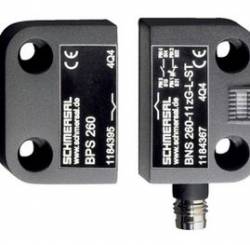
Schmersal 101184377 BNS 260-02Z-ST-L Safety Sensor
| Lieske Part No. | 852700 |
|---|---|
| Mfg Part No | 101184377 |
| EAN-Code | |
| Manufacturer | Schmersal |
| Here only | 68,01 EUR
80,93 EUR incl. VAT
|
Further information for Schmersal 101184377 BNS 260-02Z-ST-L Safety Sensor
| General | |
| Degree of protection | IP67 |
| Operation temperature | -25 ... +70 °C |
| Switching distance Sao | 5 mm |
| Switching distance Sar | 15 mm |
| Number of normally closed contacts | 2 |
| Maximum switching voltage | 75 VDC |
| Switching current max. | 0,4 A |
| Switching capacity max. | 10 VA |
| Switching frequency max. | 5 Hz |
| Connection type | M8 connector |
| Torque | 0,3 Nm |
| Rated insulation voltage Ui | 50 VAC |
| Rated impulse withstand voltage Uimp | 0,8 kV |
| Rated short-circuit current | 100 A |
| Service life | 20 years |
| Housing material | Plastic, glass-fibre reinforced thermoplastic |
| Installation conditions | Quasi-flat |
| Actuating element | Magnet |
| Hinge position | Left |
| Direction of motion | Frontal to active surface |
| Vibration resistance | 10 ... 55 Hz, amplitude 1 mm |
| Shock resistance | 30 g / 11 ms |
| Approvals | cULus |
Applications
The sensor is designed for use in safety-critical installations, for example in the packaging industry, conveyor technology, or machine tools. It is used to monitor the status of protective grilles, doors, or covers. The coding according to EN ISO 14119 is implemented at a low level, enabling simple integration into existing safety concepts. The operating temperature ranges from -25 °C to +70 °C, allowing use in indoor and outdoor environments under normal industrial conditions.
Functions and Equipment in Detail
The sensor features two safety contacts, configured as openers (NC). The switching capacity is up to 10 VA at a switching voltage of up to 75 VDC and a switching current of 0.4 A. The maximum switching frequency is 5 Hz. Contacts S11-S12 and S21-S22 must be integrated into the safety circuit to ensure reliable operation. The recommended actuator is the BPS 260.
Technology Explained Simply
The sensor operates magnetically, with the actuation magnet closing the electrical contacts when it is within the switching distance. The secured switching distance ON" (Sao) is 5 mm, while the secured switching distance "OFF (Sar) is 15 mm. This means the sensor switches securely when the magnet passes within 5 mm of the active surface, and switches off securely when the distance exceeds 15 mm. The protection rating IP67 ensures dust and water tightness, enabling use in outdoor or humid environments. The rated insulation voltage is 50 VAC, and the rated impulse voltage withstand is 0.8 kV.
Compatibility and Accessories
The sensor is equipped with an M8 connector, to be connected with a tightening torque of 0.3 Nm. Recommended safety switching devices include models SRB-E-301ST and SRB-E-201LC. The accessory XCSDMC790L01M8, a small magnetic switch with M8 inputs, is also available and can be used as an actuator. Pin assignment for versions with integrated connector is indicated in parentheses.
Mounting and Installation
Mounting is quasi-flush, with the active surface of the sensor aligned frontally to the direction of movement of the actuation magnet. Dimensions are 13 mm (length), 26 mm (width), and 36 mm (height). The housing is made of glass-fibre-reinforced thermoplastic, providing high mechanical stability and resistance to mechanical stress. Vibration resistance is 10 to 55 Hz with an amplitude of 1 mm, and shock resistance is 30 g / 11 ms.
Operational Advantages
The sensor offers a long service life of 20 years and a B10D value of 25,000,000 switching operations for the openers (NC). This ensures reliable performance over an extended period. The IP67 protection rating and temperature resistance from -25 to +70 °C allow flexible integration into various environments. Integration into existing safety concepts is simplified by the low coding level and clear switching logic.

This is an offer of:
79279 Vörstetten
https://industry-electronics.com
Tel. 07666/88499-0
Fax. 07666/88499-111
Diesen Artikel finden Sie unter:
industry-electronics.com/artikel/852700

Lieske Elektronik e.K.
Reutener Str. 1079279 Vörstetten
https://industry-electronics.com
Tel. 07666/88499-0
Fax. 07666/88499-111
Diesen Artikel finden Sie unter:
industry-electronics.com/artikel/852700