
Schmersal BNS 260-02ZG-ST-R safety sensor
Industrial Material > Control devices / Pilot devices > Initiators, inductive / capacitive
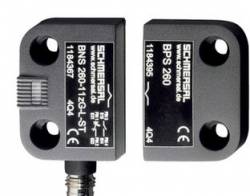
Schmersal BNS 260-02ZG-ST-R safety sensor
| Lieske Part No. | 125856 |
|---|---|
| Mfg Part No | 101184365 |
| EAN-Code | 4030661524313 |
| Manufacturer | Schmersal |
| Here only | 67,41 EUR
80,22 EUR incl. VAT
|
Further information for Schmersal BNS 260-02ZG-ST-R safety sensor
| General | |
| Degree of protection | IP66, IP67 |
| Operation temperature | -25 °C |
| Storage temperature | -25 °C |
| Relative humidity | 93 % |
| RFID frequency | 125 kHz |
| RFID transmit power (max.) | -6 dB/m |
| Holding force (FZh) | 2000 N |
| Maximum holding force (Fmax) | 2600 N |
| Latching force | 30 N |
| Actuation speed (max.) | 0,2 m/s |
| Response time (max.) | 100 ms |
| Risk time (max.) | 200 ms |
| Auxiliary voltage (Aux) | 24 VDC |
| Auxiliary voltage (Aux) tolerance | ±10 % |
| AS-Interface voltage | 26,5–31,6 VDC |
| Max. switching frequency | 1 Hz |
| Connection type | M12 plug-in connector, 4-pole, A-coding |
| Mounting screws | 2x M6 |
| Tightening torque (max.) | 8 Nm |
| Housing material | Plastic, glass-fibre reinforced thermoplastic |
| Performance level | e |
| Category | 4 |
| SIL | suitable for SIL 3 |
| PFH value | 1,81 x 10⁻⁹ /h |
| PFD value | 1,59 x 10⁻⁴ |
| Service life | 20 years |
Applications
The sensor is designed for use in machine and plant engineering, particularly in environments where high safety integrity is required. It is suitable for securing protective covers, machine doors, cabins, and other movable components that must prevent access to hazardous areas when open. The protection rating IP66 and IP67 makes it suitable for outdoor use or in damp, dusty environments. The operating temperature ranges from -25 °C to +60 °C, enabling use under various climatic conditions.
Functions and Equipment in Detail
The sensor operates on the standby current principle and monitors both the actuator and the holding force. The integrated status indicator with LEDs in green, red, and yellow signals the operating status, communication errors, or detected faults. The emergency release is possible using a triangular key, which is included in the delivery. The coding is universal and corresponds to the Low coding level according to EN ISO 14119, enabling flexible integration into existing systems. The RFID frequency is 125 kHz, and the maximum transmission power is -6 dB/m.
Technology Explained Simply
The RFID technology enables contactless communication between the sensor and the actuator, avoiding mechanical wear. The AS-Interface integration (Version 3.0, Profile S-7.B.F.E) ensures bidirectional data transmission, so the sensor not only reports the status but also transmits diagnostic information. The maximum holding force of 2600 N ensures that the protective cover remains securely closed even under load. The response time is maximum 100 ms, and the risk time is maximum 200 ms, enabling compliance with strict safety regulations. The mechanical service life is at least 1,000,000 switching cycles, ensuring high operational reliability over a long period.
Compatibility and Accessories
The sensor is compatible with the recommended actuators AZ/AZM201-B1 and AZ/AZM201-B30. For communication via AS-Interface, a stable PELV supply voltage is required. A triangular key for emergency release is included as accessory. Additional accessories, such as the magnetic switch XCSDMC790L01M8, can be used to implement additional safety functions.
Mounting and Installation
Mounting is done using two M6 mounting screws, with a maximum tightening torque of 8 Nm. Connection is made via an integrable M12 connector with 4-pole A-coding. The actuation speed must not exceed 0.2 m/s to ensure safe operation. Installation requires a stabilized PELV power supply for auxiliary voltage (24 VDC ±10 %) and an AS-Interface voltage in the range of 26.5 to 31.6 VDC.
Operational Advantages
The sensor offers high reliability through integrated diagnostics and a long service life of up to 20 years. The SIL 3-capable safety integrity makes it suitable for critical applications. The integrated status indicator enables quick fault detection and maintenance. The AS-Interface communication reduces cable count and simplifies system integration. The protection rating IP66/IP67 ensures high environmental resistance, even under harsh operating conditions.

This is an offer of:
79279 Vörstetten
https://industry-electronics.com
Tel. 07666/88499-0
Fax. 07666/88499-111
Diesen Artikel finden Sie unter:
industry-electronics.com/artikel/125856

Lieske Elektronik e.K.
Reutener Str. 1079279 Vörstetten
https://industry-electronics.com
Tel. 07666/88499-0
Fax. 07666/88499-111
Diesen Artikel finden Sie unter:
industry-electronics.com/artikel/125856