
Ruckus 901-T750-WW51 Access Point WiFi6 AX3600 Outdoor
Networks > Wireless Networking > Access Points
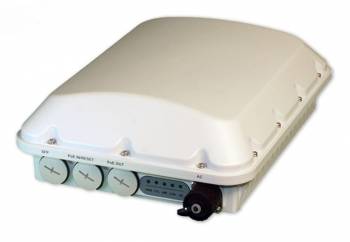
Ruckus 901-T750-WW51 Access Point WiFi6 AX3600 Outdoor
| Lieske Part No. | 1558143 |
|---|---|
| Mfg Part No | 901-T750-WW51 |
| EAN-Code | |
| Manufacturer | Ruckus |
| Here only | 2.366,87 EUR
2.816,58 EUR incl. VAT
|
Further information for Ruckus 901-T750-WW51 Access Point WiFi6 AX3600 Outdoor
| General | |
| WLAN standard | IEEE 802.11a, IEEE 802.11b, IEEE 802.11g, IEEE 802.11n, IEEE 802.11ac, IEEE 802.11ax |
| Wi-Fi standard | Wi-Fi 6 |
| Antenna technology | MIMO |
| Aerial gain | 3 dBi |
| Degree of protection | IP67 |
| Minimum operating temperature | -40 °C |
| Maximum operating temperature | 65 °C |
| Application area | Outdoor |
| PoE standard | 802.3at, 802.3bt (Type 3) |
| Backhaul options | SFP, 2.5 GbE |
| Maximum data rate | 2400 Mbit/s |
| Spatial streams | 8 (4x4:4 at 5 GHz, 4x4:4 at 2.4 GHz) |
| Maximum number of clients | 1024 |
| Technology | OFDMA, MU-MIMO |
| IoT functionality | integrated BLE and ZigBee |
| Colour | White |
| Mounting method | Mast |
Applications
The T750 is specifically designed for outdoor use and meets IP67 protection rating, ensuring dust- and water-tight conditions even under direct precipitation. The operating temperature ranges from -40 °C to 65 °C, enabling use in extreme climatic conditions. Installation is done on a mast, allowing flexible deployment in various outdoor applications.
Features and Equipment in Detail
The device offers two backhaul options: an SFP port and a 2.5-Gbit/s multi-gigabit Ethernet port, ensuring that the backhaul does not become a bottleneck for full Wi-Fi capacity utilization. Power supply is via PoE+ (802.3at) or PoE++ (802.3bt, Type 3), with an optional power supply unit available. The integrated BLE and ZigBee technology makes the access point IoT-capable, allowing integration into convergent networks that include both Wi-Fi and IoT technologies. A USB port enables connection to additional devices.
Technology Explained Simply
Support for Wi-Fi 6 (IEEE 802.11ax) provides higher efficiency and capacity compared to previous standards. OFDMA (Orthogonal Frequency Division Multiple Access) enables better frequency utilization by allowing multiple users to communicate simultaneously on different frequency bands. MU-MIMO (Multi-User Multiple Input Multiple Output) allows simultaneous communication with multiple clients, improving network performance in dense environments. The BeamFlex+ technology optimizes signal transmission through adaptive antenna patterns that adjust to the specific environment.
Compatibility and Accessories
The T750 is compatible with a mounting kit for various Ruckus models (T350, T610, T710, T750). For power supply, a PoE injector with 60 W multi-gigabit Ethernet (1.0/2.5/5.0/10.0 Gbps) can be used, suitable for multiple Ruckus models. The integrated BLE and ZigBee technology enables use in IoT networks, and the device is also expandable with a plug-in IoT module for future technologies.
Mounting and Installation
Installation is done on a mast, taking into account the device dimensions (height 10.17 cm, width 34.64 cm, depth 24.06 cm) and weight of 2.84 kg. Management is performed via local physical or virtual appliances, with automatic provisioning and firmware updates supported.
Operational Advantages
The T750 offers high capacity and performance in dense environments, supports a large number of clients simultaneously, and ensures stable connectivity through IP67 certification. The integrated IoT functionality enables a convergent network architecture, avoiding silo networks. Support for WPA3 enhances security against man-in-the-middle attacks. The 2.5-Gbit/s backhaul option ensures that Wi-Fi capacity is not limited by the network backbone.

This is an offer of:
79279 Vörstetten
https://industry-electronics.com
Tel. 07666/88499-0
Fax. 07666/88499-111
Diesen Artikel finden Sie unter:
industry-electronics.com/artikel/1558143

Lieske Elektronik e.K.
Reutener Str. 1079279 Vörstetten
https://industry-electronics.com
Tel. 07666/88499-0
Fax. 07666/88499-111
Diesen Artikel finden Sie unter:
industry-electronics.com/artikel/1558143