
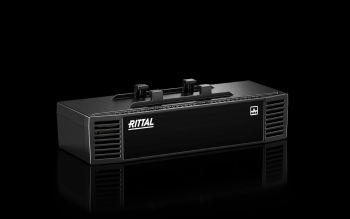
Rittal 7010210 leakage sensor CMC III
Cables > Data lines > Cat6 Patch Cable
Rittal 7010210 leakage sensor CMC III
| Lieske Part No. | 611939 |
|---|---|
| Mfg Part No | 7010210 |
| EAN-Code | 4069196000672 |
| Manufacturer | Rittal |
| Here only | 261,74 EUR
311,47 EUR incl. VAT
|
Further information for Rittal 7010210 leakage sensor CMC III
| General | |
| Model | Leakage point sensor |
| Applications | Monitoring of cabinets in IT, industry and building technology. Monitoring of cabinets, rooms and containers in IT environment. |
| Function principle | Settings can be made via the CMC III Processing Unit, the PDU, or via the IoT Interface. The leakage point sensor features an external probe mounted vertically to the floor. The sensor monitors the floor for conductive liquids (leakage) using two contacts. |
| Material | Plastic |
| Surface protection | Front: smooth, Housing: textured |
| Colour | RAL 9005 |
| Scope of delivery | Leakage sensor, external sensor probe with cable, mounting plate, including fastening material |
| Connection to CAN bus | Direct |
| Interfaces | 2 x RJ45 CAN-bus |
| Width | 110 mm |
| Height | 30 mm |
| Depth | 40 mm |
| Operating temperature range | 0 °C...45 °C |
| Humidity (non-condensing) | 5...95 % |
Applications
The sensor is designed for use in IT infrastructures, industrial plants, and building technology, where the risk of fluid leaks from cooling systems, water damage, or other sources exists. It is particularly suitable for use in server rooms, enclosures, containers, and other closed technical environments, where early notification of fluid contact is necessary to prevent damage to electronic components. Monitoring occurs directly at floor level, enabling even small leaks to be detected.
Functions and Equipment in Detail
The leakage point sensor features a compact plastic housing in RAL 9005 color, with a structured surface on the housing and a smooth front side. Dimensions are 110 mm width, 30 mm height, and 40 mm depth. The sensor is supplied with an external probe connected to the device via a cable with connector. Installation is carried out using the included mounting plate and fastening materials. Warning and alarm notifications are displayed via the software of Rittal embedded devices, enabling centralized monitoring and documentation.
Technology Explained Simply
The sensor’s technology is based on measuring electrical conductivity between two contacts on the probe. When a conductive liquid bridges the gap between these two points, an electrical resistance is measured and interpreted as an alarm. Power supply is provided via the CAN-Bus interface, eliminating the need for additional power sources. The CAN-Bus connection enables serial communication with higher-level devices, with data transmission occurring through two RJ45 connectors. The sensor’s protection rating is IP 20 according to EN 60 529, meaning it is protected against solid foreign objects (e.g., dust) but not against water. The sensor probe itself has an IP 65 rating, making it dust-tight and splash-proof, suitable for outdoor or humid environments.
Compatibility and Accessories
The sensor is compatible with Rittal embedded devices such as the CMC III Processing Unit, PDU, LCP, and IoT Interface. Connection is made via the CAN-Bus interface, and sensors can also be connected to each other in a bus configuration. Communication occurs through the integrated RJ45 connectors. Settings and configurations can be adjusted via the software of the higher-level devices. Additional sensors can be used, with the number and arrangement varying depending on application and environment.
Installation and Mounting
Installation is carried out using the included mounting plate and fastening materials. The external sensor probe is mounted vertically to the floor, with positioning chosen to cover the area where fluid leakage is most likely. Connection to the sensor is made via the cable with connector. Connection to the CAN-Bus system is achieved through the RJ45 connectors. Automatic detection and integration into the system is handled via Plug & Play, eliminating the need for manual configuration.
Operational Advantages
The sensor provides reliable and early detection of fluid leaks, helping to prevent damage to electronic components. Power supply via the CAN-Bus reduces the number of required cables and simplifies installation. Automatic detection and integration into the system reduces configuration time. Centralized display of warning and alarm notifications via the software of Rittal embedded devices enables efficient monitoring and documentation. The IP 65 protection rating of the sensor probe ensures robust use in humid or splash-prone environments.
Operating Environment
The sensor can operate within a temperature range of 0 °C to 45 °C, with sources indicating a range of 0 °C to 55 °C. Relative humidity is 5 % to 95 %, non-condensing. The operating environment must be dry and dust-free, as the IP 20 rating does not provide water tightness. However, the sensor probe is protected to IP 65, making it suitable for use in humid environments.
Scope of Delivery
The scope of delivery includes the leakage sensor, the external sensor probe with connection cable, the mounting plate, and the fastening materials.

This is an offer of:
79279 Vörstetten
https://industry-electronics.com
Tel. 07666/88499-0
Fax. 07666/88499-111
Diesen Artikel finden Sie unter:
industry-electronics.com/artikel/611939

Lieske Elektronik e.K.
Reutener Str. 1079279 Vörstetten
https://industry-electronics.com
Tel. 07666/88499-0
Fax. 07666/88499-111
Diesen Artikel finden Sie unter:
industry-electronics.com/artikel/611939