
RAK Wireless 315014 LoRa Gateway WisDuo Breakout Board
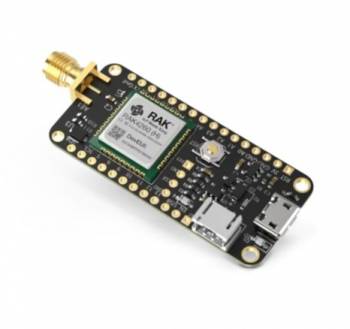
RAK Wireless 315014 LoRa Gateway WisDuo Breakout Board
| Lieske Part No. | 1020690 |
|---|---|
| Mfg Part No | 315014 |
| EAN-Code | |
| Manufacturer | RAK Wireless |
| Here only | 30,95 EUR
36,83 EUR incl. VAT
|
Further information for RAK Wireless 315014 LoRa Gateway WisDuo Breakout Board
| General | |
| Manufacturer | RAK Wireless |
| Product type | Breakout Board |
| Module | RAK4260 |
| Technology | LoRa |
| Frequency range | 862 to 1020 MHz |
| Reception sensitivity | -148 dBm |
| Maximum transmit power | 20 dBm |
| Receiving current | 17 mA |
| Clock frequency | 48 MHz |
| Microcontroller | SAML21 32-bit |
| Flash memory | 256 KB |
| RAM | 32 KB |
| SPI flash | 2 MB |
| USB functionality | native |
| Bootloader | UF2 |
| LiPo charger | built-in, 100 mA |
| Analog inputs | 6 x 12-bit |
| Analogue output | 1 x 10-Bit (DAC) |
| IO pins | 20 |
| Form factor | Feather |
| Authentication chip | ATECC608A |
| Charging status indicator | LED |
| Mounting holes | 4 |
| Scope of delivery | 1x BastWAN development board, 1x antenna for LoRa, 1x Micro-USB cable, 1x set of jumper wires |
| Reset button | |
| Power/Enable pin | |
Applications
This board is suitable for prototypes and development projects in the field of wireless communication, particularly in environments where long operational life and low power consumption are important. It can be combined with existing expansion boards to connect sensors and actuators, making it suitable for applications in Smart Agriculture, industrial automation, or environmental monitoring. Support for LoRaWAN enables integration into existing networks based on the LoRaWAN standard.
Features and Equipment in Detail
The RAK3244 features native USB functionality implemented via a Micro-USB connector. This enables direct communication with a host computer and firmware loading through a USB bootloader. The integrated UF2 bootloader allows reprogramming by simply dragging and dropping a firmware file, without requiring special tools. Additionally, the bootloader is BOSSA-compatible, enabling use with the Arduino IDE, MakeCode, and other development environments. The board is delivered pre-assembled, tested, and programmed with the bootloader.
Technology Explained Simply
The core of the board is the RAK4260 module, based on the Microchip R34 LoRa® SiP. This module combines a 32-bit microcontroller with a LoRa transceiver in a single housing, making the board compact and energy-efficient. The reception sensitivity reaches up to -148 dBm, indicating high sensitivity to weak signals. The maximum transmission power is 20 dBm, ensuring sufficient range for many applications. The typical reception current is 17 mA, highlighting its suitability for battery-powered devices. The board supports various modulations, including LoRa, (G)FSK, and (G)MSK, making it flexible for different communication requirements.
Compatibility and Accessories
The board is equipped with an ATECC608A Crypto Authentication chip for secure authentication and encryption. Additionally, it offers 2 MB of SPI Flash memory for additional data or firmware. Power supply is provided via an integrated 100 mA LiPo charger, which can be charged through the Micro-USB connector. Charging status is indicated by an LED. The board features 20 IO pins available for various interfaces such as PWM, hardware serial, I2C, and SPI. It supports six 12-bit analog inputs and one 10-bit analog output (DAC). The pinout follows the Feather standard, ensuring compatibility with a wide range of expansion boards. Compatible accessories include, for example, the LoRa WisDuo Evaluation Board RAK4200, the RAK4260 module, the RAK3172 module, and various breakout boards.
Mounting and Installation
The board is pre-assembled and tested. Installation is done via the Micro-USB connector, which serves both for power supply and communication. Firmware can be easily reprogrammed via the UF2 bootloader. Mounting is achieved through four holes suitable for securing the board to a housing or PCB. The use of jumper wires allows circuit adaptation to specific requirements.
Advantages in Operation
The combination of low power consumption, high sensitivity, and integrated USB functionality makes the board particularly suitable for energy-efficient, battery-powered applications. LoRaWAN support enables integration into existing networks. The open platform with Arduino support and open-source firmware simplifies development and customization for specific requirements. Easy reprogramming via the UF2 bootloader significantly reduces development effort.
Scope of Delivery
The product is delivered with the following components: 1x BastWAN development board, 1x LoRa antenna, 1x Micro-USB cable, and 1x set of jumper wires.

This is an offer of:
79279 Vörstetten
https://industry-electronics.com
Tel. 07666/88499-0
Fax. 07666/88499-111
Diesen Artikel finden Sie unter:
industry-electronics.com/artikel/1020690

Lieske Elektronik e.K.
Reutener Str. 1079279 Vörstetten
https://industry-electronics.com
Tel. 07666/88499-0
Fax. 07666/88499-111
Diesen Artikel finden Sie unter:
industry-electronics.com/artikel/1020690