
Promag GiTAG1Q-01 Transponder Card 125 kHz
Office Equipment > RFID-Products
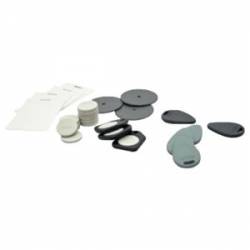
Promag GiTAG1Q-01 Transponder Card 125 kHz
| Lieske Part No. | 739721 |
|---|---|
| Mfg Part No | GiTAG1Q-01 |
| EAN-Code | |
| Manufacturer | Promag |
| Here only | 2,01 EUR
2,39 EUR incl. VAT
|
Further information for Promag GiTAG1Q-01 Transponder Card 125 kHz
| General | |
| Frequency | 125 kHz |
| Chip type | EM4102 |
| Memory capacity | 64 Bit |
| Format | CR80 |
| Thickness | 0,8 mm |
| Function | rewritable |
Applications
The transponder card is suitable for applications requiring robust, contactless identification. This includes access control systems for buildings, offices, or rooms, time and attendance control systems, and systems for identifying employees, equipment, or goods. Due to its low thickness of 0.8 mm and CR80 format, it conforms to the standard format for credit cards and check cards, enabling seamless integration into existing card reader systems. The card is designed for indoor use, with specific environmental requirements depending on the respective reader and writer hardware.
Features and Equipment in Detail
The card features an integrated transponder chip EM4102, operating in the 125 kHz frequency range. This chip is known for its stability and low sensitivity to electromagnetic interference. The 64-bit memory capacity allows storage of a unique ID number used for identifying the carrier or object. The rewritable nature of the card enables stored data to be modified using suitable reader and writer devices, allowing reuse in dynamic systems. The card is manufactured in CR80 format, matching the standard format for credit cards, and has a thickness of 0.8 mm, making it suitable for use in standard card readers.
Technology Explained Simply
The EM4102 transponder chip operates in the low-frequency range (125 kHz), meaning communication between the card and reader device occurs via inductive coupling. Energy for powering the chip and data transmission is transferred through the electromagnetic field generated by the reader device. The card itself requires no internal power supply, as it operates passively and draws energy from the reader’s field. The 64-bit memory capacity is sufficient for a unique identification number, commonly used in many access systems. Rewritability allows the ID number or other data to be changed without needing to issue a new physical card.
Compatibility and Accessories
The transponder card is compatible with reader and writer devices supporting the EM4102 chip and the 125 kHz frequency range. This includes many common access control systems, time stamping devices, and identification systems used in commercial and industrial environments. The card is not associated with specific accessories; it is delivered as a standalone product. Use requires a compatible reader device operating at 125 kHz and supporting the EM4102 chip.
Mounting and Installation
The card is not mounted but directly integrated into the respective system. The user holds it near the reader device or inserts it into a card reader, depending on whether the system is contactless or contact-based. Installation requires no special tools or mounting procedures, as the card is delivered as a finished product. Operation involves simply bringing the card close to the reader device or inserting it into the card reader, where communication occurs automatically.
Operational Advantages
The transponder card offers a reliable and cost-efficient solution for contactless identification. Rewritability reduces replacement needs and costs for new cards. Compatibility with common 125 kHz systems enables easy integration into existing infrastructures. The low thickness of 0.8 mm and CR80 format ensure universal usability in standard card readers. The passive operation of the card means no batteries or external power supply are required, simplifying maintenance and operation.

This is an offer of:
79279 Vörstetten
https://industry-electronics.com
Tel. 07666/88499-0
Fax. 07666/88499-111
Diesen Artikel finden Sie unter:
industry-electronics.com/artikel/739721

Lieske Elektronik e.K.
Reutener Str. 1079279 Vörstetten
https://industry-electronics.com
Tel. 07666/88499-0
Fax. 07666/88499-111
Diesen Artikel finden Sie unter:
industry-electronics.com/artikel/739721