
Portech MV-370-4G VoIP Gateway 1x SIM
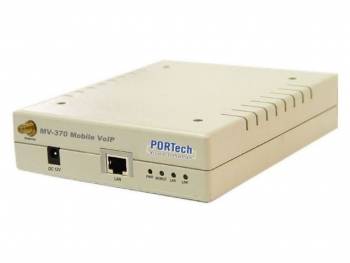
Portech MV-370-4G VoIP Gateway 1x SIM
| Lieske Part No. | 1632521 |
|---|---|
| Mfg Part No | MV-370-4G |
| EAN-Code | |
| Manufacturer | Portech |
| Here only | 348,18 EUR
414,33 EUR incl. VAT
|
Further information for Portech MV-370-4G VoIP Gateway 1x SIM
| General | |
| Number of ports | 1 Port |
| Function | VoIP to GSM/UMTS/LTE and vice versa |
| Supported protocols | SIP (RFC2543, RFC3261), TCP/IP, IP, TCP, UDP, RTP, RTCP, ICMP, ARP, RARP, SNTP, DHCP, DNS Client, IEEE802.1P/Q, ToS/DiffServ, NAT Traversal, STUN, uPnP, IP Assignment, Static IP, DHCP, PPPoE |
| Codec support | G.711 u-Law, G.711 a-Law, G.729A, G.729A/B |
| Speech quality | VAD, CNG, AEC, LEC, packet loss |
| Routing settings | 50 LAN → MOBILE, 50 MOBILE → LAN |
| LTE FDD bands | B1/B2/B3/B4/B5/B7/B8/B12/B13/B18/B19/B20/B25/B26/B28 |
| LTE TDD bands | B38/B39/B40/B41 |
| WCDMA bands | B1/B2/B4/B5/B6/B8/B19 |
| GSM bands | B2/B3/B5/B8 |
| Compatibility | Asterisk, Trixbox, SIP Proxy Server |
| IP address assignment | Static, DHCP, PPPoE |
| Callback function | |
| CDR specification | |
Applications
This gateway is designed for businesses and service providers requiring a flexible and scalable connection between fixed and mobile networks. It is suitable for applications such as call centers, security services, remote maintenance systems, or for integrating mobile communication channels into existing IP telephony systems. The global support for LTE-FDD and LTE-TDD bands, as well as WCDMA and GSM frequencies, makes it suitable for use in various regions worldwide.
Functions and Features in Detail
The device offers 50 entries for routes from LAN to mobile (LAN → MOBILE) and 50 entries for routes from mobile to LAN (MOBILE → LAN). It supports single-stage dialing as well as two-stage dialing in two modes: assigned mode and free mode. Configuration and status queries can be performed via voice response by calling from a mobile phone. The functions are configurable via a web interface, enabling centralized control. The gateway supports SMS message reception and sending, and allows control via AT commands, facilitating integration into custom software solutions.
Technology Explained Simply
The gateway operates according to the SIP (Session Initiation Protocol) standard as defined in RFC2543 and RFC3261, enabling connection with other SIP-compatible devices and servers. It supports various codec formats such as G.711 u-Law, G.711 a-Law, G.729A and G.729A/B to optimize voice quality. Additional features such as VAD (Voice Activity Detection), CNG (Comfort Noise Generation), AEC (Acoustic Echo Cancellation), and LEC (Line Echo Cancellation) improve sound quality and reduce interference. Support for NAT-Traversal, STUN, and uPnP simplifies network configuration in complex environments. The IP address can be assigned statically, via DHCP, or PPPoE.
Compatibility and Accessories
The gateway is designed for use with SIM cards connected via the Internet. It is compatible with various VoIP systems and SIP servers. Support for LTE-FDD bands B1, B2, B3, B4, B5, B7, B8, B12, B13, B18, B19, B20, B25, B26, B28, LTE-TDD bands B38, B39, B40, B41, WCDMA bands B1, B2, B4, B5, B6, B8, B19, and GSM bands B2, B3, B5, B8 enables use in a wide range of mobile networks worldwide. Communication occurs via TCP/IP protocols such as IP, TCP, UDP, RTP, RTCP, ICMP, ARP, RARP, SNTP, DHCP, DNS Client, IEEE802.1P/Q, ToS/DiffServ.
Installation and Mounting
Installation is performed via a LAN connection, with the gateway configured through a web interface. Setup requires entering network settings, SIP server parameters, and routing rules. The configuration is accessible via a web browser, allowing setup even from remote locations. Device configuration is done via the web interface, where all functions such as SMS processing, call forwarding, and voice responses are controlled through the interface.
Operational Advantages
Thanks to central SIM card management and the ability to operate the gateway at various locations, the MV-370-4G offers high flexibility. Support for 4G LTE and global frequency bands ensures stable connectivity in different regions. Integration into existing VoIP systems requires no additional hardware, enabling efficient use of infrastructure. The web-based configuration and the ability to perform status queries via voice response simplify maintenance and monitoring of the device.

This is an offer of:
79279 Vörstetten
https://industry-electronics.com
Tel. 07666/88499-0
Fax. 07666/88499-111
Diesen Artikel finden Sie unter:
industry-electronics.com/artikel/1632521

Lieske Elektronik e.K.
Reutener Str. 1079279 Vörstetten
https://industry-electronics.com
Tel. 07666/88499-0
Fax. 07666/88499-111
Diesen Artikel finden Sie unter:
industry-electronics.com/artikel/1632521