
PLANET MGB-SX Mini GBIC SX Module 550 m
Networks > Switches > Miscellaneous
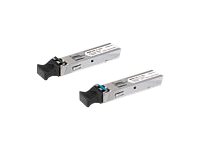
PLANET MGB-SX Mini GBIC SX Module 550 m
| Lieske Part No. | 673883 |
|---|---|
| Mfg Part No | MGB-SX |
| EAN-Code | 4711213686252 |
| Manufacturer | PLANET |
| Here only | 16,89 EUR
20,10 EUR incl. VAT
|
Further information for PLANET MGB-SX Mini GBIC SX Module 550 m
| General | |
| PHY type | IEEE 802.3z 1000BASE-SX |
| Plug connection | LC |
| Maximum range | 220 - 550 m |
| Compatibility | IEEE 802.3ab / 802.3z |
| Signal detect indicator | TTL |
| Interface | Differential PECL |
| Operation temperature | 0 - 60 °C |
Applications
This module is suitable for use in local area networks (LAN), particularly in environments requiring high data rates over medium distances, such as office buildings, industrial facilities, or building cabling. The maximum range of up to 550 meters makes it especially suitable for connections between different floors or building sections, where copper cabling would be insufficient due to distance or bandwidth requirements. The operating temperature range of 0 °C to 60 °C allows use in indoor environments and controlled outdoor areas, provided environmental conditions remain within the specified range.
Functions and Features in Detail
The PLANET MGB-SX features a duplex LC connector, ensuring a secure and stable optical connection. Data transmission occurs over multimode fiber, with the PHY specification IEEE 802.3z 1000BASE-SX forming the basis for data transfer. A TTL signal detect indicator enables visual verification of signal presence, which is helpful for troubleshooting and maintenance. Differential PECL inputs and outputs provide a robust electrical interface that minimizes interference and enhances signal quality. Plug-and-play installation simplifies setup, as no additional configuration is required—the module is simply inserted into the SFP port and is immediately operational.
Technology Explained Simply
The SFP transceiver converts electrical signals into optical signals and vice versa, enabling data transmission via light pulses over fiber cables. The 1000BASE-SX protocol allows a data rate of 1 Gigabit per second over multimode fiber. The use of LC connectors is widespread in modern networks due to their compact size and reliability. The maximum range of 550 meters is typical for multimode fiber applications and depends on fiber quality—range is greater with 50/125 µm fiber than with 62.5/125 µm. The PECL interface (Positive Emitter-Coupled Logic) ensures high signal integrity, especially at high data rates.
Compatibility and Accessories
The module is designed for SFP ports in switches and other network devices supporting the 1000BASE-SX standard. It is compatible with multimode fiber cables equipped with LC connectors. Use with other fiber types (e.g. single-mode) is not intended and not supported. Integration into existing Gigabit Ethernet networks requires no additional configuration, as the module meets the necessary standards.
Installation and Mounting
Installation is performed by simply inserting the module into the SFP port of the network device. No additional tools or configuration steps are required. The plug-and-play functionality enables quick commissioning. Correct alignment of the LC connector is important to ensure a stable optical connection. The operating temperature range of 0 °C to 60 °C requires installation in environments within this range.
Operational Advantages
The module provides reliable and fast data transmission over medium distances, with plug-and-play functionality simplifying installation. The TTL signal detect function enables quick diagnosis of connection issues. The PECL interface ensures high signal quality, which is particularly beneficial in environments with electromagnetic interference. Compatibility with common Gigabit Ethernet standards ensures easy integration into existing networks.

This is an offer of:
79279 Vörstetten
https://industry-electronics.com
Tel. 07666/88499-0
Fax. 07666/88499-111
Diesen Artikel finden Sie unter:
industry-electronics.com/artikel/673883

Lieske Elektronik e.K.
Reutener Str. 1079279 Vörstetten
https://industry-electronics.com
Tel. 07666/88499-0
Fax. 07666/88499-111
Diesen Artikel finden Sie unter:
industry-electronics.com/artikel/673883