
Pilz 751103 Safety Relay 24 VDC 2 n/o
Industrial Material > Industrial relays and contactors > Safety relay
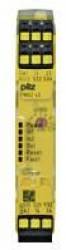
Pilz 751103 Safety Relay 24 VDC 2 n/o
| Lieske Part No. | 562061 |
|---|---|
| Mfg Part No | 751103 |
| EAN-Code | 4046548025552 |
| Manufacturer | Pilz |
| Here only | 183,02 EUR
217,79 EUR incl. VAT
|
Further information for Pilz 751103 Safety Relay 24 VDC 2 n/o
| General | |
| Device type | safety switchgear |
| Operating voltage | 24 V DC |
| Inputs | 1/2-channel wiring with/without cross-connection detection |
| Starting method | Manual/automatic start |
| Outputs | 2 S, 1 HL |
| Terminal type | pluggable spring force terminals |
| Application | monitoring of emergency stop, safety doors, light barriers |
Applications
This safety switching device is used in production plants, machine building, and automation technology, where safe shutdown of drives or machines is required in hazardous situations. It monitors the integrity of safety functions such as emergency stop buttons, safety doors, or light grids to ensure a safe response in case of failure or tampering. The 1/2-channel configuration allows flexible connection to various safety sensors, with cross-circuit detection optionally activated to detect unauthorized connections between channels.
Functions and Equipment in Detail
The device features two safety-oriented (S) outputs and one auxiliary output (HL), which can be used to control drives, warning lights, or other safety components. The inputs support both manual and automatic start, allowing the device to be flexibly integrated into existing control logic. The pluggable spring-cage terminals facilitate installation and maintenance, as they can be changed or removed without tools. The operating voltage of 24 V DC is widely used in industrial electrical engineering and enables easy integration into existing power supply systems.
Technology Explained Simply
The safety switching device operates on the principle of redundant monitoring: the inputs are monitored in a 1- or 2-channel mode, with cross-circuit detection ensuring that no unauthorized electrical connections exist between the channels. This increases the reliability of the safety function. The outputs are designed to activate only when all inputs show the required state. The operating voltage of 24 V DC is supplied via the network or an external power source, with voltage fluctuations needing to remain within specified limits to ensure proper operation.
Compatibility and Accessories
The device is compatible with accessories from the PNOZsigma series, including the PNOZsigma PAA, which serves as an additional module for extended functions. Additionally, pluggable replacement terminals (3-pole) are available for use in case of wear or terminal replacement. The PNOZ S Terminator Plug (10 pieces) is used for terminating open lines and prevents unwanted signals. These components enable flexible expansion and maintenance of the system.
Mounting and Installation
The device is mounted in standard DIN control panels, with its width of 17.5 mm allowing for compact placement. The pluggable spring-cage terminals allow for quick and secure wiring without additional tools. Installation must follow the requirements of applicable standards and safety regulations, with correct wiring of inputs and outputs being crucial for proper function. The operating voltage of 24 V DC must be supplied via a suitable network or external power source.
Advantages in Operation
The safety switching device offers high reliability through redundant monitoring and cross-circuit detection. The pluggable terminals simplify maintenance and reduce installation time. Compatibility with other PNOZsigma modules enables modular system expansion. The operating voltage of 24 V DC is widely used in industry, simplifying integration into existing installations. The clear structure of the outputs (2 S, 1 HL) enables precise control of safety functions.

This is an offer of:
79279 Vörstetten
https://industry-electronics.com
Tel. 07666/88499-0
Fax. 07666/88499-111
Diesen Artikel finden Sie unter:
industry-electronics.com/artikel/562061

Lieske Elektronik e.K.
Reutener Str. 1079279 Vörstetten
https://industry-electronics.com
Tel. 07666/88499-0
Fax. 07666/88499-111
Diesen Artikel finden Sie unter:
industry-electronics.com/artikel/562061