
Pilz 750102 Safety Relay 24 V DC 3 n/o 1 n/c
Industrial Material > Industrial relays and contactors > Safety relay
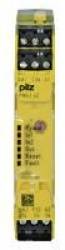
Pilz 750102 Safety Relay 24 V DC 3 n/o 1 n/c
| Lieske Part No. | 685910 |
|---|---|
| Mfg Part No | 750102 |
| EAN-Code | 4046548025699 |
| Manufacturer | Pilz |
| Here only | 176,20 EUR
209,68 EUR incl. VAT
|
Further information for Pilz 750102 Safety Relay 24 V DC 3 n/o 1 n/c
| General | |
| Device type | safety switchgear |
| Series | PNOZsigma |
| Operation mode | Standalone |
| Inputs | 1-channel wiring without cross-connection detection |
| Start function | Manual/automatic start |
| Outputs | 3 S, 1 Ö, 1 HL |
| Operating voltage | 24 V DC |
| Terminal type | Screw terminals, plug-in type |
| Monitoring function | Emergency stop, safety doors |
Applications
This device is intended for use in safety-critical applications, particularly for monitoring emergency stop switches and safety doors in manufacturing and processing industries. It is used in machines and plants where safe shutdown in the event of a fault is required. The single-channel wiring without short-circuit detection is suitable for applications where no additional diagnostic function for short circuits is needed. The functions of manual and automatic start allow for flexible integration into existing control logic.
Functions and Equipment in Detail
The safety switching device features three safety-oriented (S) outputs, used for controlling safety functions such as drive shutdown or activation of emergency stop signals. The normally open (Ö) output can be used, for example, to indicate an operating status, while the auxiliary contact (HL) can be used for additional control tasks. The plug-in screw terminals simplify installation and maintenance, as they can be mounted and removed without tools. The operating voltage of 24 V DC is a standard value in industrial electrical engineering and allows integration into existing power supply systems.
Technology Explained Simply
The device operates as a standalone safety relay, functioning independently of a higher-level control system. The single-channel wiring means that a single input channel is used for monitoring, with no integrated short-circuit detection. This reduces complexity and is sufficient for applications where no additional diagnostic function is required. The outputs are designed to handle safety-oriented functions, with the three S outputs intended for direct control of safety functions. The operating voltage of 24 V DC is a common voltage in industrial automation technology and ensures reliable operation.
Compatibility and Accessories
The device is compatible with accessories from the PNOZsigma series, including plug-in screw terminals and terminator plugs. The screw terminals enable secure and quick connection of cables, while the terminator plugs serve as end connections in the control system. These components are available optionally and can be added according to installation requirements. Compatibility with the PNOZsigma series ensures uniform integration into existing safety architectures.
Mounting and Installation
The device is mounted in standard DIN control panels, with a width of 17.5 mm allowing for compact placement. The plug-in screw terminals allow for simple and tool-free wiring. Installation is typically carried out by qualified specialists who consider the requirements of safety standards. Wiring of inputs and outputs is done according to the device’s technical documentation.
Advantages in Operation
The combination of compact design, plug-in screw terminals, and single-channel wiring without short-circuit detection makes the device a cost-efficient solution for simple safety applications. The operating voltage of 24 V DC is widely used and reduces the need for additional power supplies. The standalone function enables independent safety monitoring that does not depend on a higher-level control system. The outputs are clearly defined, simplifying integration into existing plants.

This is an offer of:
79279 Vörstetten
https://industry-electronics.com
Tel. 07666/88499-0
Fax. 07666/88499-111
Diesen Artikel finden Sie unter:
industry-electronics.com/artikel/685910

Lieske Elektronik e.K.
Reutener Str. 1079279 Vörstetten
https://industry-electronics.com
Tel. 07666/88499-0
Fax. 07666/88499-111
Diesen Artikel finden Sie unter:
industry-electronics.com/artikel/685910