
Pepperl+Fuchs NCB15-30GM40-N0 inductive sensor
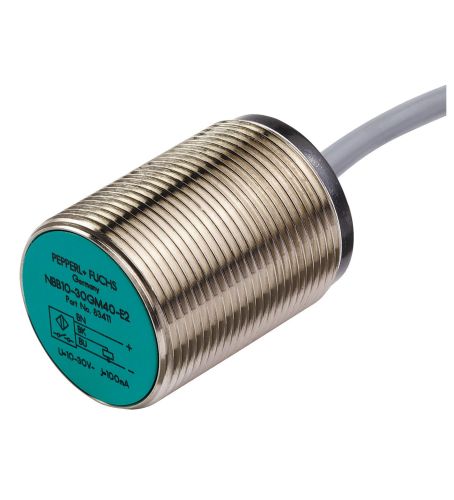
Pepperl+Fuchs NCB15-30GM40-N0 inductive sensor
| Lieske Part No. | 1061100 |
|---|---|
| Mfg Part No | 70133070 |
| EAN-Code | 4050143454822 |
| Manufacturer | Pepperl+Fuchs |
| Here only | 88,57 EUR
105,40 EUR incl. VAT
|
Further information for Pepperl+Fuchs NCB15-30GM40-N0 inductive sensor
| General | |
| Switching function | Breaker contact (NC) |
| Output type | NAMUR |
| Type of output | 2-wire |
| Thread type | M30 |
| Construction type | Cylinder, screw-thread |
| Product series | Cylindrical |
| Safety integrity level (SIL) | SIL 2 |
| Voltage type | DC |
| Device protection level Ga | IECEx PTB 11.0037X |
| Device protection level Gb | IECEx PTB 11.0037X |
| Device protection level Da | IECEx PTB 11.0037X |
| Device protection level Dc (tc) | IECEx TUR 21.0018X |
| Device protection level Mb | IECEx PTB 11.0037X |
| Built-in | quasi flush |
| Temperature range | extended |
Applications
The sensor is designed for use in hazardous areas and meets the requirements for device protection levels Ga, Gb, Da, Dc (tc) and Mb according to IECEx certification. The certification numbers IECEx PTB 11.0037X and IECEx TUR 21.0018X confirm compliance with international safety standards. This makes it particularly suitable for applications in the chemical industry, petrochemicals, process engineering, and other areas where explosion hazards exist. The extended temperature range allows use in environments with high thermal loads, ensuring reliable operation even in processes with elevated temperatures.
Functions and Equipment in Detail
The sensor features a thread size M30, enabling secure and standardized mounting in various machine construction designs. The cylindrical design allows for compact integration in limited space. The switching function as a normally closed (NC) contact is useful for applications where a signal loss in case of failure must be detected, for example in safety circuits. The NAMUR output type is a standard in industrial sensor technology and allows direct connection to control systems equipped with NAMUR inputs. The 2-wire configuration reduces the number of required cables and simplifies installation.
Technology Explained Simply
The NAMUR interface operates with a voltage fluctuation triggered by the presence of a metallic object in close proximity to the sensor. This state is interpreted as a switching event and results in a change in electrical resistance in the output circuit. The use of direct current (DC) ensures a constant power supply, independent of fluctuations in mains voltage. The SIL certification at Level 2 (Safety Integrity Level) indicates that the sensor is suitable for applications with medium safety risk, where high reliability and fault tolerance are required. The certifications for device protection levels Ga, Gb, Da, Dc (tc) and Mb guarantee that the sensor can be safely operated in various hazardous areas.
Compatibility and Accessories
The sensor is designed for use in systems that support NAMUR standard interfaces. It can be used in combination with control systems equipped with corresponding inputs. The M30 thread allows for use with standard mounting elements and brackets available for this thread size. The IECEx certifications make it compatible with international safety requirements in hazardous areas.
Mounting and Installation
The quasi-flush mounting enables a flat installation on surfaces, allowing the sensor to be easily integrated into limited space. Mounting is done via the M30 thread, which is screwed into the corresponding holes or brackets. Wiring is done via the 2-wire connection, directly connected to the control system or safety circuit. Installation requires no special tools or additional components, as the sensor is designed as a standalone component.
Operational Advantages
The sensor offers high reliability through SIL 2 certification and IECEx certifications, ensuring safe operation in hazardous areas. The extended temperature range allows use in thermally demanding environments without impairing functionality. The NAMUR interface and 2-wire configuration reduce wiring complexity and facilitate integration into existing systems. The cylindrical design with M30 thread ensures universal mounting capability in various industrial applications.
Safety Integrity Level (SIL)
The sensor is certified for use in systems with Safety Integrity Level SIL 2, meaning it can be used in applications where a malfunction of the sensor could lead to a medium risk. This includes, for example, monitoring movements in machines or detecting objects in production processes, where a false alarm or sensor failure could potentially be dangerous. The SIL certification ensures that the sensor exhibits sufficient fault tolerance and reliability under defined conditions.
Device Protection Levels
The certifications for device protection levels Ga, Gb, Da, Dc (tc) and Mb according to IECEx indicate that the sensor can be safely operated in various hazardous areas. The certification numbers IECEx PTB 11.0037X and IECEx TUR 21.0018X confirm compliance with internationally recognized safety standards. This enables use in areas where flammable gases, vapors, or dusts may be present, ensuring safe operation without explosion risk.
Extended Temperature Range
The sensor is designed for use in environments with elevated temperatures. The extended temperature range allows reliable operation even at high ambient temperatures, making it particularly suitable for applications in process engineering or processes with thermal stress. The exact temperature limit is specified in the technical data, but the information in the text is not detailed enough to state a specific value.

This is an offer of:
79279 Vörstetten
https://industry-electronics.com
Tel. 07666/88499-0
Fax. 07666/88499-111
Diesen Artikel finden Sie unter:
industry-electronics.com/artikel/1061100

Lieske Elektronik e.K.
Reutener Str. 1079279 Vörstetten
https://industry-electronics.com
Tel. 07666/88499-0
Fax. 07666/88499-111
Diesen Artikel finden Sie unter:
industry-electronics.com/artikel/1061100