
Pepperl+Fuchs 288060 MLV12-54-G-7134 reflex sensor
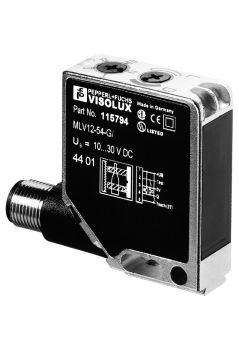
Pepperl+Fuchs 288060 MLV12-54-G-7134 reflex sensor
| Lieske Part No. | 831767 |
|---|---|
| Mfg Part No | 288060 |
| EAN-Code | 4050143159901 |
| Manufacturer | Pepperl+Fuchs |
| Here only | 447,93 EUR
533,04 EUR incl. VAT
|
Further information for Pepperl+Fuchs 288060 MLV12-54-G-7134 reflex sensor
| General | |
| Product type | Retro-reflective photoelectric sensor |
| Application | glazing identification |
| Transmission range | 5,6 m |
| Colour of light | Red light |
| Switching type | Day/night switching |
| Output type | PNP output |
| Teach-In | external TEACH-IN |
| Plug connection | M12 connector |
| Construction type housing | compact design |
| Housing material | metal housing frame |
| Function | automatic readjustment in case of contamination |
| Application range | detection of reflective objects and clear glass |
Reflex photoelectric sensor is the central product type, specifically designed for glass detection. The sensor detects objects that reflect light due to their surface properties (e.g. glass, metal) and signals their presence via the electrical output. The light/dark switching enables flexible use: depending on the application, the sensor can be configured to output a signal state when the object is present (light) or absent (dark). This is particularly useful in systems where the positioning of glass panels or metallic components must be monitored.
Technology explained clearly: The sensor emits a red light signal that strikes the object to be detected and is reflected. The receiver in the device detects the returning light and evaluates its intensity. If sufficient reflection is detected, the output is activated. The automatic readjustment in case of contamination ensures that the sensor continues to operate reliably even with slight contamination of the optics or changes in environmental conditions, by automatically adjusting sensitivity. This increases operational safety and reduces maintenance requirements. The metal housing frame provides high mechanical stability and protects internal components from mechanical stress.
Compatibility and accessories: The sensor is equipped with an M12 connector, enabling a standardised and robust connection to cables and connectors. Suitable mounting aids are available, including the mounting aid OMH-MLV12-HWK (part number 115150) and the mounting aid OMH-MLV12-HWG (part number 115151), which facilitate installation at various mounting points. These accessories support secure and precise positioning of the sensor in use.
Mounting and installation: Mounting is typically done at a fixed position, with the optics precisely aligned towards the object to be detected. The mounting aids enable quick and secure fastening. Wiring is done via the M12 connector, which is suitable for industrial applications and ensures a reliable electrical connection. Adjustment of contrast detection is performed using the external Teach-In switch, which is used during commissioning to adapt the sensor to the specific reflection properties of the object.
Advantages in operation: The sensor offers high reliability in detecting reflective and transparent materials, which is beneficial in many production environments. Automatic readjustment reduces the need for manual maintenance. The combination of compact design, PNP output, and M12 connector makes it a universally applicable device in industrial automation. The red light radiation is highly visible, facilitating commissioning and troubleshooting. The compact design allows placement in tight mounting areas without impairing functionality.

This is an offer of:
79279 Vörstetten
https://industry-electronics.com
Tel. 07666/88499-0
Fax. 07666/88499-111
Diesen Artikel finden Sie unter:
industry-electronics.com/artikel/831767

Lieske Elektronik e.K.
Reutener Str. 1079279 Vörstetten
https://industry-electronics.com
Tel. 07666/88499-0
Fax. 07666/88499-111
Diesen Artikel finden Sie unter:
industry-electronics.com/artikel/831767