
Mennekes 18665 AMTRON 4Y/4B 500/700 surge protector
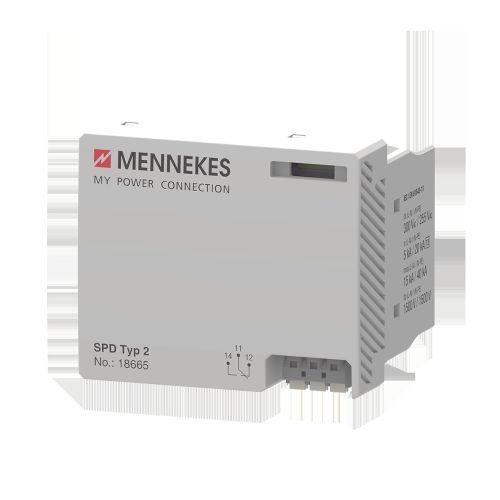
Mennekes 18665 AMTRON 4Y/4B 500/700 surge protector
| Lieske Part No. | 1063014 |
|---|---|
| Mfg Part No | 18665 |
| EAN-Code | 4015394304357 |
| Manufacturer | Mennekes |
| Here only | 80,31 EUR
95,57 EUR incl. VAT
|
Further information for Mennekes 18665 AMTRON 4Y/4B 500/700 surge protector
| General | |
| Manufacturer | Mennekes |
| Compatibility | AMTRON® 4You 500 and 4Business 700 |
| Protection function | protection against voltage surges |
| Application area | charging infrastructure for electric vehicles |
Applications
This overvoltage protection is specifically designed for use with the AMTRON® 4You 500 and 4Business 700 models. These charging stations are typically used in public or commercial charging environments such as parking garages, shopping centres, or business premises. The protection is therefore suitable for applications in outdoor areas or locations with an increased risk of electrical disturbances. Installation usually takes place within the power supply system of the charging pillar to protect the entire electronic control and charging unit from voltage surges.
Functions and Equipment in Detail
The overvoltage protection operates as a surge diverter, automatically diverting excess electrical energy when a critical voltage level is reached. This is achieved through a special protection mechanism that limits the voltage to a safe level for connected devices. The function operates without interfering with the normal operation of the charging station — once the voltage returns to the permissible range, the protection automatically reactivates. The devices are designed to protect the charging infrastructure and the connected electric vehicle from damage caused by electrical overvoltages.
Technology Explained Simply
An overvoltage protection device like the AMTRON 4Y/4B 500/700 works on the principle of voltage diversion. Under normal operating voltage, the protection remains inactive. When a voltage surge occurs that exceeds a defined threshold, the protection activates within milliseconds and diverts the excess energy through a diversion resistor or a varistor (e.g., a metal-oxide varistor). This limits the voltage at the charging infrastructure to a tolerable level. This process occurs without interrupting the charging process, as long as the voltage surge is not so high that the protection fails permanently. The technology is designed to protect sensitive electronic components in the charging pillar and the vehicle.
Compatibility and Accessories
The overvoltage protection is specifically developed for the AMTRON® 4You 500 and 4Business 700 models and is directly integrated into the power supply of these charging stations. Compatibility is limited to these two specific models, and use with other charging stations is not recommended. Installation is typically carried out by qualified personnel familiar with the electrical system of the charging pillar.
Mounting and Installation
Mounting of the overvoltage protection takes place within the power supply system of the charging pillar, typically near the main power supply cable or in the distribution box. Connections are made via existing power lines, adhering to electrical standards and safety regulations. Proper installation is essential to ensure full protective functionality.
Operational Advantages
Using the overvoltage protection significantly reduces the risk of damage to the charging infrastructure and the electric vehicle. This lowers maintenance and repair costs and increases operational safety. Charging pillars can be operated stably over a longer period without functional failures or hardware defects caused by external electrical disturbances. The reliability of the charging system is improved, which is particularly important for operators of public charging infrastructure. The protection is an integral part of the safety architecture of modern charging pillars and contributes to long-term functionality.

This is an offer of:
79279 Vörstetten
https://industry-electronics.com
Tel. 07666/88499-0
Fax. 07666/88499-111
Diesen Artikel finden Sie unter:
industry-electronics.com/artikel/1063014

Lieske Elektronik e.K.
Reutener Str. 1079279 Vörstetten
https://industry-electronics.com
Tel. 07666/88499-0
Fax. 07666/88499-111
Diesen Artikel finden Sie unter:
industry-electronics.com/artikel/1063014