
Lindner K200707 Fuse Insert gG 10A red
Installation > Securing material > D-Fuses and Accessories
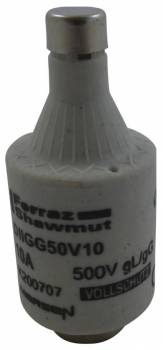
Lindner K200707 Fuse Insert gG 10A red
| Lieske Part No. | 502010 |
|---|---|
| Mfg Part No | K200707 |
| EAN-Code | 4086500000050 |
| Manufacturer | Lindner |
| Here only | 4,27 EUR
5,08 EUR incl. VAT
|
Further information for Lindner K200707 Fuse Insert gG 10A red
| General | |
| Utilization category | gG |
| Nominal current | 10 A |
| Operating voltage | 500 V AC |
| Size | DII |
| Colour | Red |
| Norm | DIN VDE 0636-30 |
| Fuse type | D-system |
| Application area | Low-voltage installations |
Applications
This fuse insert is intended for use in low-voltage installations, particularly in areas where the fuse can be replaced by non-specialized personnel. The D-fuse system includes various sizes, such as NDZ, DII, DIII, DIV, and DV. The present product belongs to size DII, designed for specific rated currents and voltages. Its application is in electrical installations where reliable protection against overload and short-circuit is required.
Functions and Features in Detail
The fuse is rated for a nominal current of 10 amperes and thus protects cables and devices operating within this current range. The red color identifies the fuse according to standard marking rules, making it quickly identifiable in the fuse box. The operating class gG means that the fuse can withstand both thermal and electrodynamic stresses during short-circuit events, ensuring high reliability in operation. The fuse is designed for an operating voltage of 500 volts AC, making it suitable for use in industrial and commercial installations.
Technology Explained Simply
The fuse operates on the principle of thermal and electromagnetic disconnection. In the event of an overcurrent or short-circuit, the fuse element inside the fuse heats up, melts, and interrupts the circuit. The operating class gG ensures that the fuse remains stable even under high short-circuit currents and safely interrupts the current without electrodynamic destruction. The standard DIN VDE 0636-30 defines the requirements for such fuses, including electrical and mechanical properties as well as testing procedures.
Compatibility and Accessories
The fuse insert is designed for use in D-fuse holders of size DII. It is compatible with standard D-fuse boxes commonly installed in many low-voltage systems. Use in other sizes or holders is not intended and may lead to malfunctions or safety risks. The fuse is part of a system designed for standardization and interchangeability, ensuring easy availability of spare parts.
Installation and Mounting
Mounting is done by inserting the fuse insert into the corresponding D-fuse holder of size DII. The screw connection provides a secure and mechanically stable connection. Installation must be carried out in electrically de-energized systems, complying with the relevant electrical installation safety regulations. The fuse is not intended for use in explosive environments.
Operational Advantages
The fuse provides reliable protection against overload and short-circuit, extending the service life of connected devices and cables. The simple replaceability by non-specialists reduces maintenance time and dependence on skilled personnel. Compliance with DIN VDE 0636-30 ensures high safety standards required in industrial and commercial installations. The operating class gG ensures robust performance even under extreme conditions.

This is an offer of:
79279 Vörstetten
https://industry-electronics.com
Tel. 07666/88499-0
Fax. 07666/88499-111
Diesen Artikel finden Sie unter:
industry-electronics.com/artikel/502010

Lieske Elektronik e.K.
Reutener Str. 1079279 Vörstetten
https://industry-electronics.com
Tel. 07666/88499-0
Fax. 07666/88499-111
Diesen Artikel finden Sie unter:
industry-electronics.com/artikel/502010