
Lapp 2173002 UNITRONIC TRAIN MVB 2x2x0,5 bus cable
Cables > Data lines > Data cables coaxial
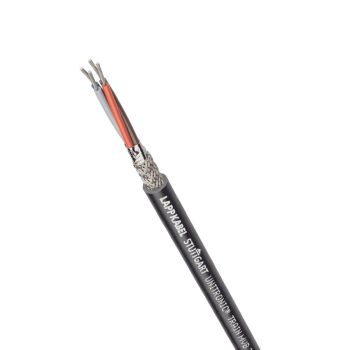
Lapp 2173002 UNITRONIC TRAIN MVB 2x2x0,5 bus cable
| Lieske Part No. | 695964 |
|---|---|
| Mfg Part No | 2173002 |
| EAN-Code | 4044777483013 |
| Manufacturer | Lapp |
| Here only | 10,72 EUR
12,76 EUR incl. VAT
|
Further information for Lapp 2173002 UNITRONIC TRAIN MVB 2x2x0,5 bus cable
| General | |
| Rated shaft resistance | 120 Ohm |
| Cable type | Bus wiring |
| Application | rail vehicles, buses |
| Installation method | Fixed installation |
| Compatibility | TCN according to IEC 61375 |
| MVB standard | IEC 61375-3-1 |
| WTB standard | IEC 61375-2-1 |
| Construction | 2x2x0,5 |
| Core cross section | 0,5 mm² |
| Temperature resistance | elevated ambient temperature |
| Chemical resistance | oily environment |
| Fire spread | reduced |
| Diameter | 8,3 mm |
| EMC optimisation | |
Applications
This cable is primarily designed for use in rail vehicles and buses, where reliable and robust data transmission under harsh operating conditions is required. It is used in the TCN system, which consists of the communication systems WTB (Wire Train Bus) and MVB (Multifunction Vehicle Bus). These systems enable the networking of various vehicle components, such as controls, brakes, lighting, and air conditioning, over a unified network.
Functions and Features in Detail
The UNITRONIC® TRAIN MVB 2x2x0.5 features a nominal characteristic impedance of 120 Ohms, which is necessary for optimal signal transmission in CAN-bus systems. The cable’s construction ensures high mechanical robustness and resistance to mechanical influences, making it suitable for use in vehicles subjected to high vibration and shock loads. Additionally, the cable is optimized for electromagnetic compatibility (EMC) to minimize interference from electromagnetic fields and ensure stable data transmission.
Technology Explained Simply
The designation 2x2x0.5 describes the cable’s construction: it consists of two pairs of conductors, each with a cross-section of 0.5 mm². This design is typical for bus cables used for both data transmission and power supply to control units. The cable is designed for use in environments with elevated temperatures, making it suitable for areas within the vehicle where high thermal loads occur. Its chemical resistance protects the cable from exposure to oil and other chemicals commonly found in vehicle environments.
Compatibility and Accessories
The cable is compatible with the IEC 61375-3-1 standard for MVB and IEC 61375-2-1 for WTB, which are part of the TCN system. These standards define the physical and electrical properties of bus cables to enable uniform communication within the vehicle. The cable can be connected to other TCN system components, such as control units, sensors, and actuators, which are also connected to the TCN.
Installation and Mounting
The cable is designed for fixed installation, meaning it is not intended for frequent movement or bending. Installation typically occurs during vehicle assembly, with the cable routed along predefined paths. Connections to devices are made using appropriate connectors designed for use in the TCN system.
Operational Advantages
The cable offers an extended temperature range, enabling use in various environments. Its reduced flame spread helps protect people and property in the event of a fire. High mechanical robustness and EMC optimization ensure reliable and stable data transmission, even under harsh operating conditions. Good chemical resistance increases the cable’s service life in oily environments.

This is an offer of:
79279 Vörstetten
https://industry-electronics.com
Tel. 07666/88499-0
Fax. 07666/88499-111
Diesen Artikel finden Sie unter:
industry-electronics.com/artikel/695964

Lieske Elektronik e.K.
Reutener Str. 1079279 Vörstetten
https://industry-electronics.com
Tel. 07666/88499-0
Fax. 07666/88499-111
Diesen Artikel finden Sie unter:
industry-electronics.com/artikel/695964