
Kioxia KCM9DRUL1T92 SSD 1.92TB U.3 NVMe SED
Computer-Components > Hard Drives > SSD PCIe
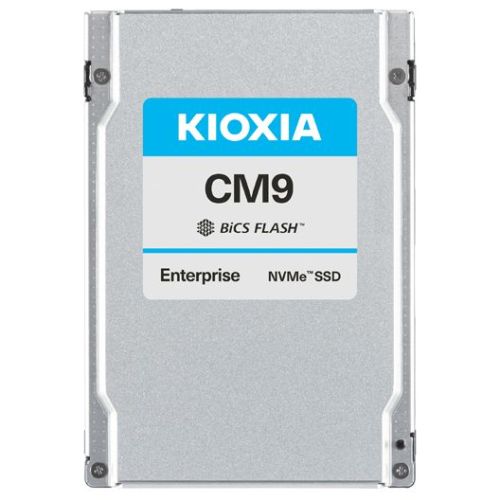
Kioxia KCM9DRUL1T92 SSD 1.92TB U.3 NVMe SED
| Lieske Part No. | 2519355 |
|---|---|
| Mfg Part No | KCM9DRUL1T92 |
| EAN-Code | |
| Manufacturer | Kioxia |
| Here only | 1.974,50 EUR
2.349,65 EUR incl. VAT
|
Further information for Kioxia KCM9DRUL1T92 SSD 1.92TB U.3 NVMe SED
| General | |
| Capacity | 1.92 TB |
| Interface | PCIe 5.0 x4 |
| Form factor | U.3 |
| Reading speed | 14.500 MB/s |
| Write speed | 3.600 MB/s |
| 4K IOPS read | 2.050.000 IOPS |
| 4K IOPS write | 170.000 IOPS |
| Workload | 1 DWPD |
| Total write volume | 3.504 TBW |
| Technology | NVMe |
| Function | Self-encrypting drive (SED) |
Applications
The SSD is primarily designed for enterprise applications, such as data centers, high-availability servers, virtualization platforms, and high-performance computing environments. Its high IOPS performance for random read and write operations makes it particularly suitable for applications with high access demands, such as databases, cloud infrastructures, or real-time analytics. The U.3 form factor integration enables flexible mounting in rack servers and supports hot-swap functionality, simplifying system maintenance and expansion.
Features and Specifications in Detail
The SSD achieves sequential read and write speeds of up to 14,500 MB/s and 3,600 MB/s. These values are typical for PCIe Gen5 x4 SSDs and enable fast data transfer, especially during large file transfers or processing of large data blocks. For random access (4K IOPS), the device reaches up to 2,050,000 read and 170,000 write operations per second, ensuring high parallel processing capability. The integrated SED function supports data encryption according to common standards and can be managed via management tools to control access to sensitive information.
Technology Explained Simply
The PCIe Gen5 x4 interface offers a bandwidth of 32 GT/s per lane, enabling a theoretical maximum transfer rate of 64 GB/s overall. The SSD efficiently utilizes this bandwidth to achieve the specified speeds. NVMe technology (Non-Volatile Memory Express) optimizes communication between memory and processor by reducing latency and increasing the parallelism of data access. The U.3 form factor platform is a standard for enterprise SSDs and allows use in 2.5-inch or 3.5-inch server bays, with power supply and data transmission handled via a single cable. The SED function means encryption is integrated into the SSD’s controller, providing higher security against physical attacks.
Compatibility and Accessories
The SSD is designed for systems supporting the U.3 form factor, particularly in servers with hot-swap capability. Compatibility with PCIe Gen5 x4 host controllers is required to achieve maximum performance. Use in systems with lower PCIe generations (e.g., Gen4) will result in reduced performance due to limited bandwidth.
Installation and Mounting
Installation is performed in U.3-compatible server bays, where the SSD is inserted into a hot-swap tray and then placed into the server. Power supply and data transmission are handled via the integrated cable, which connects directly to the server controller. No additional drivers are required, as NVMe SSDs are natively supported by modern operating systems. Configuration of the SED function is done via management tools provided by the server platform or operating system.
Operational Advantages
The SSD offers high I/O performance, which is critical for applications with high access demands. The 5-year manufacturer warranty, with a workload of 1 DWPD (Drive Writes Per Day) and a total write amount of 3,504 TBW (Terabyte Written), demonstrates the device’s high endurance. The integrated encryption enhances data security without significantly impacting performance. The U.3 form factor integration allows easy integration into existing server infrastructures and supports hot-swap functions, simplifying system maintenance and expansion.

This is an offer of:
79279 Vörstetten
https://industry-electronics.com
Tel. 07666/88499-0
Fax. 07666/88499-111
Diesen Artikel finden Sie unter:
industry-electronics.com/artikel/2519355

Lieske Elektronik e.K.
Reutener Str. 1079279 Vörstetten
https://industry-electronics.com
Tel. 07666/88499-0
Fax. 07666/88499-111
Diesen Artikel finden Sie unter:
industry-electronics.com/artikel/2519355