
Kioxia KCD8XVUG1T60 SSD 1.60TB 2.5" PCIe4.0
Computer-Components > Hard Drives > SSD PCIe
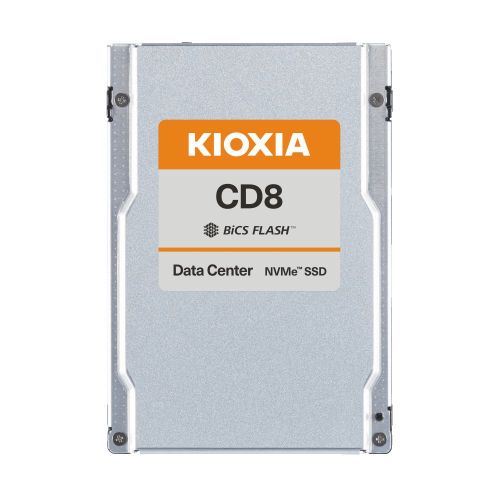
Kioxia KCD8XVUG1T60 SSD 1.60TB 2.5" PCIe4.0
| Lieske Part No. | 904511 |
|---|---|
| Mfg Part No | KCD8XVUG1T60 |
| EAN-Code | 4582563857483 |
| Manufacturer | Kioxia |
| Here only | 1.517,23 EUR
1.805,50 EUR incl. VAT
|
Further information for Kioxia KCD8XVUG1T60 SSD 1.60TB 2.5" PCIe4.0
| General | |
| Capacity | 1,6 TB |
| Interface | PCIe 4.0 x4 - |
| Form factor | U.2 - |
| Protocol | NVMe - |
| Sequential read speed | 7200 MB/s |
| Sequential write speed | 3500 MB/s |
| 4K IOPS read operations | 1250000 IOPS |
| 4K IOPS write operations | 310000 IOPS |
| Workload | 3 DWPD - |
| Function | sanitize instant erase (SIE) - |
Applications
The SSD is primarily intended for use in data centers and enterprise computing centers, where high IOPS values, high throughput rates, and high reliability over an extended period are required. Its construction as a 2.5-inch SSD with a height of 15 mm (63.5 mm length) allows installation in standard 19-inch rack systems. The specification of 3 DWPD (Drive Writes Per Day) makes it suitable for medium to high write loads, such as those occurring in virtual machines, databases, or backup systems.
Functions and Features in Detail
The SSD achieves sequential read speeds of up to 7,200 MB/s and sequential write speeds of up to 3,500 MB/s. For random 4K operations, the values are 1,250,000 IOPS for read operations and 310,000 IOPS for write operations. These values are typical for enterprise SSDs and ensure fast response times for many small accesses, as occur in file systems or databases. The sanitize instant erase (SIE) function enables immediate, secure erasure of all data on the SSD, without requiring a lengthy erasure process. This is particularly important when reusing or disposing of devices.
Technology Explained Simply
The use of PCIe Gen4 x4 and NVMe protocol ensures a direct, fast connection between the SSD and the host system, without requiring an additional bridge. NVMe technology was specifically developed for SSDs and optimally utilizes the parallel processing capability of the PCIe interface. The specification of 3 DWPD means the SSD can be fully written to three times per day without prematurely affecting its lifespan. The five-year warranty, combined with a write endurance of 8,760 TBW (Terabytes Written), underscores the high reliability of the device.
Compatibility and Accessories
The SSD is designed for systems that support the U.2 form factor. This typically includes server and rack systems equipped with corresponding slots. The use of NVMe requires a host controller that supports NVMe. The SSD is not suitable for use in standard PCs or notebooks without a U.2 slot.
Mounting and Installation
The SSD has dimensions of 63.5 mm (length) × 15 mm (height) and conforms to the 2.5-inch form factor. It is installed in standard 19-inch rack systems with U.2 slots. Mounting is typically done using screws or a retention bracket, with the exact method depending on the specific server or rack system. Power supply is provided via the U.2 cable, which simultaneously transmits data and power.
Operational Advantages
The high IOPS performance and fast sequential speeds ensure high system performance, especially in applications involving many small accesses. The SIE function enables fast and secure data erasure, simplifying compliance with data protection regulations. The five-year warranty and high write endurance of 3 DWPD make the SSD a reliable solution for professional use. The use of PCIe Gen4 x4 and NVMe ensures efficient bandwidth utilization and minimizes latencies.

This is an offer of:
79279 Vörstetten
https://industry-electronics.com
Tel. 07666/88499-0
Fax. 07666/88499-111
Diesen Artikel finden Sie unter:
industry-electronics.com/artikel/904511

Lieske Elektronik e.K.
Reutener Str. 1079279 Vörstetten
https://industry-electronics.com
Tel. 07666/88499-0
Fax. 07666/88499-111
Diesen Artikel finden Sie unter:
industry-electronics.com/artikel/904511