
JUNG 2225WSU KNX Weather Station Universal
Installation > Home Automation > EIB material
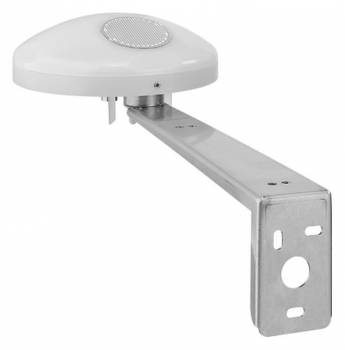
JUNG 2225WSU KNX Weather Station Universal
| Lieske Part No. | 186201 |
|---|---|
| Mfg Part No | 2225WSU |
| EAN-Code | 4011377127562 |
| Manufacturer | JUNG |
| Here only | 947,69 EUR
1.127,75 EUR incl. VAT
|
Further information for JUNG 2225WSU KNX Weather Station Universal
| General | |
| ETS product family | Phys. Sensors |
| Product type | Weather station |
| Measurement parameters | wind speed, wind direction, precipitation, brightness, global radiation, twilight, temperature, relative humidity, air pressure |
| Calculated weather data | Absolute humidity, perceived temperature, comfort |
| Integrated technology | GPS/GLONASS receiver, bus coupler, integrated heater |
| Functions | Shading control, measurement data acquisition, limit value monitoring, software logic modules |
| Operating voltage | 24 VAC |
| Accessories | power supply WSSV10, mounting arm 2225 BFA, connection cable 2225 CAB |
Applications
The weather station is designed for integration into intelligent building automation systems, particularly in installations operating on KNX protocols. It is suitable for buildings with automated ventilation, heating, shading, and lighting systems, where environmental conditions are used to control technical installations. The measurement data can be used, for example, to automatically adjust blinds, ventilation units, or heating systems according to current weather conditions.
Functions and Equipment in Detail
The 2225WSU measures basic weather parameters such as wind speed, wind direction, precipitation, brightness, global radiation, dusk, temperature, relative humidity, and air pressure. Additionally, the device calculates further meteorological values from the measured data, including absolute humidity, feels-like temperature, and comfort level. An integrated GPS/GLONASS receiver enables automated position determination, which is relevant for accurate sensor calibration and geographical assignment of measurement data. The station features an integrated heater that protects the sensors at low temperatures and ensures measurement accuracy.
Technology Explained Simply
The weather station is equipped with an integrated bus coupler that enables direct communication with the KNX bus. This bus serves as the data and control line for networking home automation systems. The measurement values are continuously recorded and can be linked and processed via software logic modules in the ETS platform (Engineering Tool Software). The shading control function allows blinds or awnings to be automatically adjusted according to brightness and solar radiation. The measurement data acquisition and threshold monitoring enables the definition of limit values, and when these are exceeded, specific actions can be triggered, for example, shutting off ventilation systems during heavy rain.
Compatibility and Accessories
The weather station is part of the ETS product family Phys. Sensors and requires an additional power supply for reliable operation, available under article number WSSV10. This power supply delivers 24 VAC and is specifically designed for the weather station and analog inputs. Replacement parts include the mounting arm (art. no. 2225 BFA) and the connection cable (art. no. 2225 CAB), which are used for maintenance or component replacement.
Installation and Mounting
Installation takes place outdoors, preferably on roof or facade surfaces, to ensure representative acquisition of environmental conditions. The device is installed using the included mounting arm and connection cable. Connection to the KNX bus is made via the integrated bus coupler.
Operational Advantages
The 2225WSU provides comprehensive data acquisition for controlling building functions. The integrated heater ensures reliable measurement even at low temperatures. Automatic position determination via GPS/GLONASS reduces manual entry of location data and increases the accuracy of weather data. Integration with software logic modules in the ETS platform enables flexible and application-specific use of measurement values in building automation.
Batteries are not included in the delivery scope.

This is an offer of:
79279 Vörstetten
https://industry-electronics.com
Tel. 07666/88499-0
Fax. 07666/88499-111
Diesen Artikel finden Sie unter:
industry-electronics.com/artikel/186201

Lieske Elektronik e.K.
Reutener Str. 1079279 Vörstetten
https://industry-electronics.com
Tel. 07666/88499-0
Fax. 07666/88499-111
Diesen Artikel finden Sie unter:
industry-electronics.com/artikel/186201