
Hager ECP382D energy meter 3-phase direct 80 A
Measurement > Counter / coin, hour meter
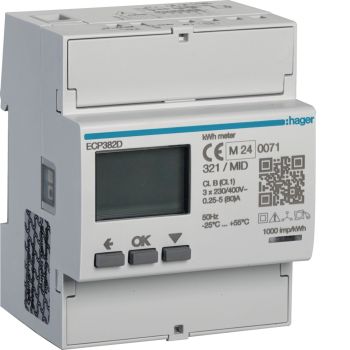
Hager ECP382D energy meter 3-phase direct 80 A
| Lieske Part No. | 877086 |
|---|---|
| Mfg Part No | ECP382D |
| EAN-Code | 3250610008164 |
| Manufacturer | Hager |
| Here only | 433,30 EUR
515,63 EUR incl. VAT
|
Further information for Hager ECP382D energy meter 3-phase direct 80 A
| General | |
| Type of meter | Electronic |
| Nominal current (In) | 80 A |
| Max. current (Imax) | 80 A |
| Nominal voltage (Un) N-L | 276 V |
| Nominal voltage (Un) L-L | 480 V |
| Frequency | 65 Hz |
| Accuracy class | B |
| Pole type | Four conductor |
| Model | Direct measurement |
| Energy type | Effective power and blind power |
| Suitable for | Purchase/supply |
| Tariff type | Two-tariff |
| Tariff control | External |
| Approval | Measuring Instruments Directive |
| Pulse output | Electrical |
| Pulse type | S0 |
| Pulse rate | 200 Imp/kWh (kvarh) |
| Type of indication | Digital |
| Mounting method | DRA (DIN-rail adapter) |
| Width in number of modular spacings | 4 |
| Type of interface | Other |
| Number of positions total (counter) | 9 |
| Degree of protection (IP) | IP20 |
| Degree of protection (NEMA) | 2 |
| Depth | 60 mm |
| Height | 92 mm |
| Power consumption | 0.6 W |
| Width | 72 mm |
| Measuring type load profile | |
| Escapement mechanism | |
| Calibrated | |
| EEC40 signature | |
| With lock code | |
Applications
The ECP382D is designed for use in electrical installations with a rated voltage of 276 V (L-N) or 480 V (L-L). It is suitable for applications in energy distribution, particularly in industrial and commercial facilities, where accurate measurement of active and reactive energy is required. The MID approval also makes it suitable for use in tariff systems where energy billing must comply with legal requirements.
Functions and Features in Detail
The meter measures active energy in accuracy class B according to DIN EN 50470-3 and reactive power in Class 2 according to IEC 62053-23. Active power is measured in Class 1 according to IEC 62053-21 and IEC 61557-12. Measurement is performed via direct measurement, with a current measurement range from 0.25 A to 80 A. The voltage ranges are 92–276 V (L-N) and 160–480 V (L-L), and frequency measurement is carried out in the range of 45–65 Hz. The reverse prevention feature prevents backward counting, which is important for measurement reliability.
Technology Explained Simply
The meter operates electronically and records energy consumption via an S0 pulse output. The pulse rate is 200 Imp/kWh (kvarh), enabling precise transmission of measurement values to external systems. Tariff control is performed externally via 230 V AC, allowing two tariff counts (T1 and T2) to be activated. Measurement data output is provided via two pulse outputs, suitable for integration into energy management systems. Power consumption is 0.6 W at rated load, representing low burden on the measurement circuit.
Compatibility and Accessories
The meter is designed for use with meter input and output cables with a cross-section of 33 mm². Mounting is on a DIN rail, with a nominal torque of 2 Nm for mechanical connections and 0.50 Nm for the digital terminal. Protection class IP20 and NEMA 2 protect against contact with moving parts and are suitable for use in enclosed switchgear. Operating temperature ranges from -25 °C to 55 °C, while storage and transport temperature ranges from -25 °C to 70 °C.
Mounting and Installation
Installation is on a DIN rail (REG), with device dimensions of 92 mm (height), 72 mm (width), and 60 mm (depth). The connection cross-sections for meter input and output cables are specified as 33 mm². Mounting requires a torque of 2 Nm for mechanical connections and 0.50 Nm for the digital terminal to ensure a secure connection.
Operational Advantages
The ECP382D offers high measurement accuracy in the specified classes and is designed for direct measurement, enabling simple installation without additional transformers. MID approval ensures legal validity of the measurement values. External tariff control via 230 V AC and data output via S0 pulse outputs facilitate integration into existing energy management systems. The reverse prevention feature ensures correct counting even with alternating load directions.

This is an offer of:
79279 Vörstetten
https://industry-electronics.com
Tel. 07666/88499-0
Fax. 07666/88499-111
Diesen Artikel finden Sie unter:
industry-electronics.com/artikel/877086

Lieske Elektronik e.K.
Reutener Str. 1079279 Vörstetten
https://industry-electronics.com
Tel. 07666/88499-0
Fax. 07666/88499-111
Diesen Artikel finden Sie unter:
industry-electronics.com/artikel/877086