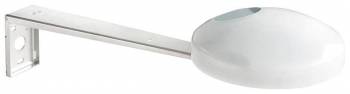
Further information for Gira 207400 Weather Station Plus KNX
General
Other bus systems
None
Model
Other
Colour
Other
Degree of protection (IP)
IP44
Bus system KNX
Bus system KNX radio
Bus system radio frequent
Bus system LON
Bus system Powernet
Radio frequent bidirectional
Bus connection included
With DCF77
Acoustic signal
With heating
Analogue input
Weather station
Weather station Plus for KNX Features: The weather station for KNX records wind speed, wind direction, precipitation, global radiation, temperature, twilight, relative humidity, air pressure and, with four sensors, brightness depending on the direction. The maximum value of the brightness sensors, absolute humidity, perceived temperature and comfort are calculated using the measured data. The area of application is automatic, weather-dependent shading control especially for the home. The weather station monitors itself in some important functions and reports corresponding errors independently via reporting objects on the bus. Monitoring of the applied voltage. The failure is reported via a communication object on the bus. With integrated bus connection. Installation outdoors on a mast or on the wall. The position of the installation location can be determined via GPS. Functions: Two limit values with adjustable hysteresis per sensor can be parameterized internally or specified as 8-bit or 16-bit values. The teach-in function enables the current measured value to be transferred to a limit value. All limit value objects have a configurable switch-on and switch-off delay. 16 logic gates (AND, AND with feedback, OR, exclusive OR, NAND, NOR) with up to 4 inputs for external and internal 1-bit values. 4 locking elements for locking functions or manual operation. Automatic shading control of up to 8 facades can be implemented with sun-position-dependent tracking of the slats and blind height control. All values can be output when the value changes and cyclically. The outputs of the locking elements can only be sent when the value changes. Cascading weather stations is possible using the logic functions. This is recommended for expanding functions (measuring wind strength on different facades) or to greatly increase functional reliability through redundancies. Notes: Measured values apply to the installation location. Deviations from other weather services are possible. All accuracy specifications of the measured values refer to the respective final value of the measuring range.