
Finder 70.61.8.400.0000 Voltage Monitoring 3ph 480VAC
Industrial Material > Industrial relays and contactors > Switching units / measuring, control relay
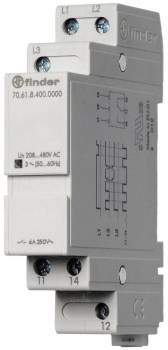
Finder 70.61.8.400.0000 Voltage Monitoring 3ph 480VAC
| Lieske Part No. | 475206 |
|---|---|
| Mfg Part No | 706184000000 |
| EAN-Code | 8012823371986 |
| Manufacturer | Finder |
| Here only | 71,29 EUR
84,84 EUR incl. VAT
|
Further information for Finder 70.61.8.400.0000 Voltage Monitoring 3ph 480VAC
| General | |
| Degree of protection | IP 20 |
| Operating voltage | 400 V AC |
| Frequency | 50/60 Hz |
| Number of contacts | 1 change-over contact |
| Max. continuous current | 6 A |
| Nominal voltage | 250 V AC |
| Max. switching voltage | 400 V AC |
| Contact material | AgSnO2, AgCdO |
| Supply voltage operating range | 170 - 500 V AC |
| Switch-on lockout time | 1 s |
| Breaking delay time | 0,5 - 60 s |
| Switch-on hysteresis | 10 V (L-L) |
| Ambient temperature | -20 - +60 °C |
| Construction type | 17.5 mm wide |
| Mounting | DIN rail 35 mm |
| Monitoring functions | phase failure, phase sequence, undervoltage, overvoltage |
| Voltage fault memory | Selectable |
| Adjustability | Front-side adjustment with screwdriver |
| LED status indicator | |
| Positive safety logic | |
| Cadmium-free contact material | |
Applications
This relay is designed for use in industrial and technical installations requiring reliable network monitoring. It is particularly suitable for systems dependent on stable 3-phase AC voltage, such as those found in manufacturing, machine building, or building automation. The monitoring functions include phase failure, phase sequence, under-voltage, and over-voltage, with detection also possible for reverse voltage. The device is intended for indoor use, as the IP 20 protection rating does not provide protection against touch or environmental moisture.
Functions and Equipment in Detail
The device features an output contact in the form of a 1-changeover contact with a maximum continuous current rating of 6 A (AC1). The contacts are made of AgSnO2 and AgCdO materials, with the contact material being cadmium-free. The maximum switching voltage is 400 V AC, and the nominal voltage is 250 V AC. The LED status indicator allows for visual monitoring of the operating state. The monitoring threshold settings are adjustable from the front using a slot or Phillips screwdriver. The voltage fault memory function is optional, allowing a fault condition to remain indicated even after voltage is restored.
Technology Explained Simply
Network monitoring is achieved through continuous voltage measurement in all three phases. Upon detection of a fault — for example, if a phase fails or the phase sequence is incorrect — the output contact opens to disconnect the connected load. The switch-on lockout time is 1 second, and the switch-off delay time can be adjusted between 0.5 and 60 seconds. The switch-on hysteresis is 10 V (L-L), meaning the voltage must exceed the threshold voltage by this amount for the contact to close again. The supply voltage operates within a range of 170 to 500 V AC, ensuring reliable operation even during voltage fluctuations.
Compatibility and Accessories
The device is designed for mounting on a 35 mm DIN rail and complies with standard EN 60715. Suitable accessories include the spacing piece 022.09, which can be used to increase the spacing between devices on the rail. Compatibility with other devices in the series 70 is possible, especially when using cage terminals for secure connections.
Mounting and Installation
Mounting is done by installing the device on a 35 mm DIN rail. The monitoring threshold settings are adjusted using a screwdriver on the front panel. The connection terminals are designed for secure connections. The ambient temperature must be between –20 °C and +60 °C to ensure proper operation. The IP 20 protection rating protects against finger contact, but not against dust or moisture.
Advantages in Operation
The relay provides reliable network monitoring with multiple integrated functions that enhance the safety and stability of systems. The front-accessible adjustment of parameters allows for flexible adaptation to different requirements. The LED indicator provides a quick visual status overview. The positive safety logic ensures that the load is safely disconnected in case of faults, preventing damage to connected devices. The use of cadmium-free contact material complies with current environmental requirements.

This is an offer of:
79279 Vörstetten
https://industry-electronics.com
Tel. 07666/88499-0
Fax. 07666/88499-111
Diesen Artikel finden Sie unter:
industry-electronics.com/artikel/475206

Lieske Elektronik e.K.
Reutener Str. 1079279 Vörstetten
https://industry-electronics.com
Tel. 07666/88499-0
Fax. 07666/88499-111
Diesen Artikel finden Sie unter:
industry-electronics.com/artikel/475206