
equip 118945 DVI-I to VGA Adapter Male/Female
Storage > Accessories
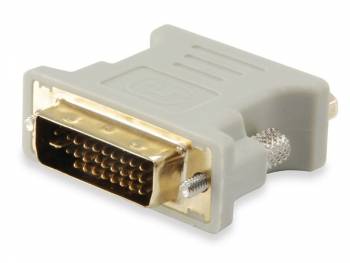
equip 118945 DVI-I to VGA Adapter Male/Female
| Lieske Part No. | 277013 |
|---|---|
| Mfg Part No | 118945 |
| EAN-Code | 4015867108970 |
| Manufacturer | Equip |
| Here only | 2,39 EUR
2,84 EUR incl. VAT
|
Further information for equip 118945 DVI-I to VGA Adapter Male/Female
| Packaging data | |
| Package width | 100 mm |
| Package depth | 0.0600 mm |
| Package height | 175 mm |
| Package weight | 36 g |
| Performance | |
| Product colour | Beige |
| Maximum resolution | 1280 x 1024 pixels |
| Ports & interfaces | |
| Connector 1 | DVI-A |
| Connector 2 | VGA |
| Connector 1 gender | Male |
| Connector 2 gender | Female |
| Weight & dimensions | |
| Width | 55 mm |
| Depth | 45 mm |
| Height | 9.8 mm |
| Weight | 25 g |
DVI-A is a digital video interface designed exclusively for transmitting video signals without audio. The adapter features a DVI-A plug at one end, which connects to a DVI-A socket, and a VGA socket at the other end, into which a VGA plug (HD15) is inserted. This configuration allows the use of existing VGA displays without requiring additional digital connections or converters.
Applications include connecting computers, KVM switches, or set-top boxes to older or compatible monitors, projectors, or televisions equipped with a VGA input. The adapter is particularly useful in office environments, when using legacy displays, or in situations where a digital signal source must be connected to an analog display. The maximum resolution supported is 1280 x 1024 pixels, which is sufficient for most standard applications.
Functions and features in detail include direct signal conversion from DVI-A to VGA, converting digital image data into an analog format. This is achieved without additional power supply, as the adapter operates passively. The connection is made via physical plug connections, with no additional components such as cables, adapter cables, or power supplies required. Use is simple: plug into the device, socket into the display – signal transmission starts automatically.
Technology explained simply means that the adapter does not perform active signal amplification or digital signal processing. It serves only as a mechanical and electrical bridge between two different interfaces. Signal quality therefore depends on the quality of the cables used and the compatibility of the devices. Conversion is passive, so no external power supply is required. The maximum resolution of 1280 x 1024 pixels represents the theoretical limit achievable under ideal conditions.
Compatibility and accessories include use with devices featuring a DVI-A output and displays equipped with a VGA input (HD15). Use with other interfaces such as DVI-I, DVI-D, or HDMI is not intended, as the adapter is specifically designed for DVI-A.
Mounting and installation require no tools. The adapter is simply plugged into the DVI-A port of the source device, and the VGA plug of the receiving device is inserted into the socket at the other end. The connection becomes active immediately upon establishing the physical link. No settings adjustments on the device or display are required, provided the devices are compatible.
Operational advantages include easy handling, small size, and low weight, making it suitable for temporary or mobile applications. The passive technology requires no additional power supply, simplifying installation. Using existing VGA displays enables cost-efficient use of available hardware without the need to upgrade to new connectors. The beige colour blends visually into typical office or IT environments.
Batteries are not included in the delivery scope.

This is an offer of:
79279 Vörstetten
https://industry-electronics.com
Tel. 07666/88499-0
Fax. 07666/88499-111
Diesen Artikel finden Sie unter:
industry-electronics.com/artikel/277013

Lieske Elektronik e.K.
Reutener Str. 1079279 Vörstetten
https://industry-electronics.com
Tel. 07666/88499-0
Fax. 07666/88499-111
Diesen Artikel finden Sie unter:
industry-electronics.com/artikel/277013