
Eltako FSR71NP-230V - Wireless actuator 2 channel impulse switching relay 30 100 865
Installation > Home Automation > Bus systems - radio
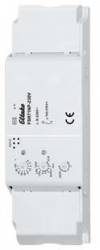
Eltako FSR71NP-230V - Wireless actuator 2 channel impulse switching relay 30 100 865
| Lieske Part No. | 628993 |
|---|---|
| Mfg Part No | 30100865 |
| EAN-Code | 4010312316221 |
| Manufacturer | Eltako |
| Here only | 93,57 EUR
111,35 EUR incl. VAT
|
Further information for Eltako FSR71NP-230V - Wireless actuator 2 channel impulse switching relay 30 100 865
Impulse switching relay 1 normally open contact not potential-free 16A/250V AC, 230V LED lamps up to 400W, incandescent lamps 2000W. With light scene control via PC or with radio buttons. Encrypted radio, bidirectional radio and repeater function can be switched on. Standby loss only 0.8 watts. Installation in the 230V mains connection cable, for example in false ceilings and lights. 166mm long, 46mm wide and 31mm high. With cable strain relief. If the supply voltage fails, the switching state is retained. When the supply voltage returns, it is switched off in a defined manner. Scene control: With one of the four control signals from a button with a double rocker that has been taught in as a scene button, several FSR71NPs can be switched on or off for one scene each. Central commands via the app are sent with a Professional Smart Home Controller. To do this, teach in one or more FSR71NPs using the respective app. The rotary switches are used to teach in the buttons and, if necessary, test the device. For normal operation, the middle and lower rotary switches are then set to AUTO. The upper rotary switch is used to set the EW time (0-120 seconds) for relays or the RV time (0-120 minutes) for impulse switches if necessary. If wireless motion brightness sensors FBH (master) and/or FBH (slave) are taught in, the upper rotary switch is used to set the switching threshold at which the lighting switches on or off. Settings for the upper rotary switch according to the operating instructions. If wireless brightness sensors are taught in, the upper rotary switch is used to set the switching threshold at which the lighting switches on or off depending on the brightness (from approx. 0 lux in position 0 to approx. 50 lux in position 120). A hysteresis of approx. 300 lux between switching on and off is fixed. An additionally set RV time is ignored. Only one FBH (master) or FAH can be programmed. If wireless window-door contacts FTK or window handle sensor FFG7B are programmed, different functions can be set with the middle rotary switch in the positions AUTO 1 to AUTO 4 and a maximum of 116 FTKs can be linked: AUTO 1 = window closed, then output active. AUTO 2 = window open, then output active. In the positions AUTO 3 and AUTO 4, the programmed FTKs are automatically linked. With AUTO 3, all FTKs must be closed for the working contact to close (e.g. for air conditioning control). With AUTO 4, an open FTK is sufficient to close the working contact (e.g. for alarm notification or switching on the power supply of an extractor hood). After a power failure, the link is restored by a new signal from the FTK or with the next status message after 15 minutes. An additionally set RV time is ignored. If water sensors are programmed,different functions can be set using the middle rotary switch in the positions AUTO 1 to AUTO 4. AUTO 1 = no water, then working contact closed. AUTO 2 = water, then working contact closed. In the positions AUTO 3 and AUTO 4, the water sensors taught in on a channel are automatically linked. With AUTO 3, all water sensors must have reported no water for the working contact to close. The working contact opens when a water sensor reports water. With AUTO 4, the working contact closes when a water sensor reports water; the working contact only opens when all water sensors have reported no water. An additionally set RV time is ignored. The LED under the upper rotary switch accompanies the teaching-in process in accordance with the operating instructions and indicates control commands during operation by flashing briefly.

This is an offer of:
79279 Vörstetten
https://industry-electronics.com
Tel. 07666/88499-0
Fax. 07666/88499-111
Diesen Artikel finden Sie unter:
industry-electronics.com/artikel/628993

Lieske Elektronik e.K.
Reutener Str. 1079279 Vörstetten
https://industry-electronics.com
Tel. 07666/88499-0
Fax. 07666/88499-111
Diesen Artikel finden Sie unter:
industry-electronics.com/artikel/628993