
Eltako 22100030 R12-100-230V Relay 16A
Installation > Modular devices / equipment installation > Impulse switch / relay
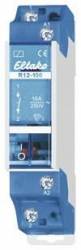
Eltako 22100030 R12-100-230V Relay 16A
| Lieske Part No. | 937059 |
|---|---|
| Mfg Part No | 22100030 |
| EAN-Code | 4010312200445 |
| Manufacturer | Eltako |
| Here only | 31,22 EUR
37,15 EUR incl. VAT
|
Further information for Eltako 22100030 R12-100-230V Relay 16A
| General | |
| Switching type | 1-pole |
| Switching power | 16 A |
| Switching voltage | 250 V AC |
| Control power | 1,9 W |
| Working time | 100 % |
| Contact arrangement | 1 make contact (NO) |
| Contact spacing | 3 mm |
| Test voltage contact/contact | 2000 V |
| Test voltage control connections/contact | 4000 V |
| Mounting method | DIN-EN 60715 TH35 |
| Built-in width | 18 mm |
| Built-in depth | 55 mm |
| Control voltage | 230 V AC |
| Compatibility | ER12DX-UC, ER12-200-UC, ER12-110-UC |
| Universal control voltage UC | 12–230 V AC/DC |
Applications
This relay is designed for use in electrical installations, particularly in enclosures or distribution boxes, where a mechanical switching function with visual feedback is required. It is suitable for applications in building automation, industrial control technology, or lighting systems, where a reliable and manually verifiable switching function is necessary. The switching capacity of 16A/250V AC allows control of medium to high loads, such as heaters, pumps, or lighting systems.
Functions and Equipment in Detail
The device features a normally open (NO) contact configuration, closing the circuit when actuated. The contact gap is 3 mm, ensuring sufficient insulation between contacts. The test voltage between contacts is 2000 V, while the test voltage between control terminals and contacts is 4000 V. These values ensure high electrical safety and prevent arcing under operating conditions. Manual operation allows for manual switching independent of control, and the switching position indicator shows whether the contact is closed or open.
Technology Explained Simply
The relay is operated by a control voltage of 230V AC, with a control power requirement of 1.9 W. Control is achieved via connected control lines that activate the relay. The normally open contact configuration means the circuit is only closed upon actuation. The mechanical design is engineered for high operational safety, with the switching position indicator providing visual confirmation of the switching state. Mounting on a DIN support rail enables standardized and space-saving installation in enclosures.
Compatibility and Accessories
The relay is connection-compatible with electronic switching relays ER12DX-UC, ER12-200-UC, and ER12-110-UC. These devices use a universal control voltage UC, covering a voltage range of 12 to 230 V AC (50–60 Hz) and 12 to 230 V DC. Compatibility allows flexible integration into existing installations, especially when planning to switch from mechanical to electronic relays. Identical terminal clamps and mounting dimensions ensure direct interchangeability without rewiring.
Mounting and Installation
Mounting is on a DIN support rail according to DIN-EN 60715 TH35. The mounting width of 18 mm corresponds to one module width, enabling standardized placement in enclosures. The mounting depth of 55 mm must be considered during enclosure depth planning. Wiring is done via the designated terminal clamps, connecting control lines to control terminals and load lines to contact terminals. Manual operation and the switching position indicator are directly visible on the device and require no additional components.
Operational Advantages
The relay offers high operational safety through its mechanical switching function and visual feedback on the switching state. The 100 % duty cycle enables continuous load switching without restriction. Compatibility with electronic relays allows future-proof planning, as switching to electronic control is possible without changing mounting or wiring. The low control power of 1.9 W reduces energy consumption of the control unit.

This is an offer of:
79279 Vörstetten
https://industry-electronics.com
Tel. 07666/88499-0
Fax. 07666/88499-111
Diesen Artikel finden Sie unter:
industry-electronics.com/artikel/937059

Lieske Elektronik e.K.
Reutener Str. 1079279 Vörstetten
https://industry-electronics.com
Tel. 07666/88499-0
Fax. 07666/88499-111
Diesen Artikel finden Sie unter:
industry-electronics.com/artikel/937059