
Elsner 71510 room temperature controller KNX sec signalws
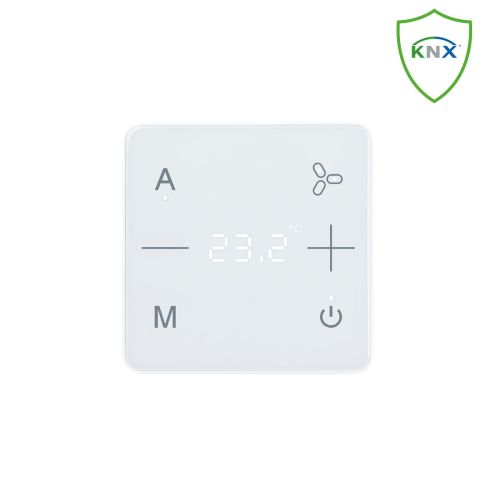
Elsner 71510 room temperature controller KNX sec signalws
| Lieske Part No. | 2035924 |
|---|---|
| Mfg Part No | 71510 |
| EAN-Code | 4051996715207 |
| Manufacturer | Elsner |
| Here only | 94,10 EUR
111,98 EUR incl. VAT
|
Further information for Elsner 71510 room temperature controller KNX sec signalws
| General | |
| Housing | Real glass, plastic |
| Colours (similar) | RAL 9003 (white), RAL 9005 (black) |
| Degree of protection | IP20 |
| Dimensions (W × H) | 81,5 mm × 81,5 mm |
| Installation depth | 12,5 mm |
| Weight total | ≈ 70 g |
| Ambient temperature | 5…+45 °C |
| rF (relative humidity) non-condensing | 0...95 % |
| Storage temperature | 25...+70 °C |
| Over voltage category | III |
| Pollution degree | 2 |
| KNX bus | |
| Medium | TP1-256 |
| Configuration mode | S-Mode |
| Maximum group addresses | 500 |
| Maximum assignments | 500 |
| Communication objects | 147 |
| Nominal voltage | 30 V DC SELV |
| Electricity consumption | ≤ 23 mA |
| Connection | KNX plug-in terminal |
| Conductor diameter | Ø 0,6...0,8 mm s |
| Strip length | 5 mm |
| Time until data reception after bus voltage recovery | ≈ 5 s |
| Sensor | |
| Temperature measurement range | 5…+60 °C |
| Humidity measurement range | 0...100 % |
Applications
The controller is primarily intended for controlling air conditioning units in summer operation, but can also be used to control KNX heating actuators in winter operation. It is therefore suitable for year-round room climate control and integrates into existing KNX infrastructures. The application is in residential and office buildings where precise and comfortable climate control is required. The use of VRF systems enables flexible and energy-efficient climate control, with the controller handling the necessary control and regulation processes.
Functions and Equipment in Detail
The device features touch-sensitive switch surfaces to set the target temperature (via +/– buttons), fan speed (1–3), operating mode (heating, cooling, dehumidifying), and operating mode (automatic/manual). An ON/OFF button allows activation or deactivation of the temperature controller. Current settings are displayed via dimmable LEDs, providing visual feedback. For control, either the measurement value of the integrated temperature sensor or humidity sensor can be used, or mixed values from internal and external sensors can be formed. The automatic mode includes a PI controller for heating, cooling, dehumidifying (single- or two-stage) and humidifying (single-stage), and includes special parameters for VRF systems.
Technology Explained Simply
The controller operates via the KNX bus system using the medium TP1-256 and in configuration mode S-Mode. The nominal voltage is 30 V DC SELV (safe extra-low voltage), with a current consumption of up to 23 mA. Communication takes place via a KNX plug-in terminal, designed for conductors with a diameter of Ø 0.6 to 0.8 mm, requiring a stripping length of 5 mm. After the bus voltage is restored, it takes approximately 5 seconds before data can be received. The maximum number of group addresses and assignments is 500 each, and 147 communication objects are available. Overvoltage category III and pollution degree 2 ensure electrical safety and functionality in typical indoor environments.
Compatibility and Accessories
Two inputs can connect either binary contacts such as pushbuttons or window contacts, or analog temperature sensors T-NTC. The integrated AND and OR logic gates allow linking of communication objects, supporting flexible control logic. As optional accessories, a temperature sensor T-NTC (part number 30516) is available, although other NTC sensors can also be used.
Mounting and Installation
Installation is carried out on a suitable device box, taking into account the mounting depth of 12.5 mm. The delivery includes a pushbutton with holder, a KNX plug-in terminal, as well as installation instructions, manual, and application software in multiple languages (German, English, French, Italian, Spanish). The installation instructions are provided in paper form, while the manual and application software are available for download.
Operational Advantages
The controller offers intuitive operation via touch-sensitive buttons and visual feedback via LEDs. Integration into KNX systems enables centralized control and monitoring. Support for mixed values and logic functions expands application possibilities. The use of SELV voltage increases safety, and the compact design with low mounting depth facilitates installation. The operating temperature range of 5 °C to +45 °C and high relative humidity tolerance of up to 95 % (non-condensing) make the device suitable for a wide range of indoor environments. The integrated sensors for temperature and humidity enable precise control of room climate.
Scope of Delivery
The scope of delivery includes the pushbutton with holder, the KNX plug-in terminal, installation instructions (in German, English, French, Italian, Spanish), the manual (available for download), and the application software (available for download). The installation instructions are provided in paper form, while the manual and application software are available digitally. No additional components such as batteries or tools are included in the delivery.

This is an offer of:
79279 Vörstetten
https://industry-electronics.com
Tel. 07666/88499-0
Fax. 07666/88499-111
Diesen Artikel finden Sie unter:
industry-electronics.com/artikel/2035924

Lieske Elektronik e.K.
Reutener Str. 1079279 Vörstetten
https://industry-electronics.com
Tel. 07666/88499-0
Fax. 07666/88499-111
Diesen Artikel finden Sie unter:
industry-electronics.com/artikel/2035924