
Elsner 71230 weather station for CasaConnect KNX
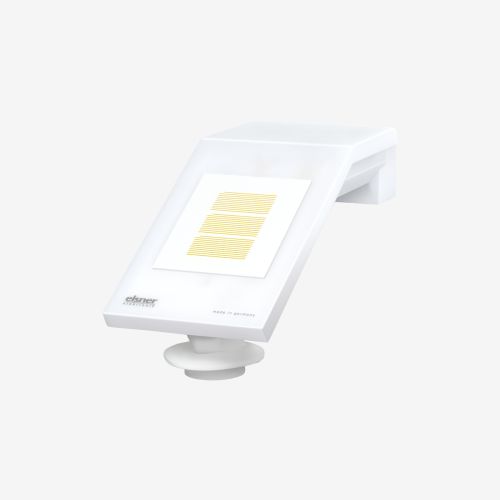
Elsner 71230 weather station for CasaConnect KNX
| Lieske Part No. | 705328 |
|---|---|
| Mfg Part No | 71230 |
| EAN-Code | 4051996712305 |
| Manufacturer | Elsner |
| Here only | 575,59 EUR
684,95 EUR incl. VAT
|
Further information for Elsner 71230 weather station for CasaConnect KNX
| General | |
| Housing | Plastic |
| Colour | white/translucent |
| Mounting | Surface or mast mounting |
| Degree of protection | IP44 |
| Dimensions (W × H × D) | 62 mm × 75 mm × 155 mm |
| Weight total | ≈ 90 g |
| Ambient temperature | 30...+50°C |
| Storage temperature | 30...+70°C |
| Connection cable 4-core (KNX bus +/-, supply voltage +/-), diameter approx. 5 mm | J-Y(ST)Y, 2 × 2 × 0,8mm |
| KNX bus | |
| Medium | TP1-256 |
| Configuration mode | S-Mode |
| Maximum group addresses | 2000 |
| Maximum assignments | 2000 |
| Communication objects | 28 |
| Electricity consumption | ≤ 10 mA |
| Time until data reception after bus voltage recovery | ≈ 4 s |
| Power supply | |
| Voltage (power supply must comply with EN 61558-1) | 20...30V DC SELV |
| Current [at] | ≤ 90 mA [24 V DC] |
| Sensors | |
| Temperature measurement range | 30...+50°C |
| Wind measurement range | 0…35 m/s |
| Brightness measurement range | 0 Lux … 99000 Lux |
Applications
The weather station is intended for use in buildings with KNX systems, particularly in installations that control automated functions such as ventilation, heating, blinds, or lighting based on environmental conditions. The measured values for wind, temperature, and brightness enable precise adjustment of building functions according to current outdoor conditions. The GPS function provides exact time and geographical coordinates, which is important for system synchronization and accurate data recording. Precipitation detection supports, for example, the control of roof drainage systems or the activation of protective measures during rain.
Functions and Equipment in Detail
The weather station measures brightness in the range of 0 to 99,000 Lux, enabling broad coverage of daylight conditions. Wind speed is electronically measured, ensuring the device operates silently and reliably, even in hail, snow, or sub-zero temperatures. The wind sensor monitoring detects disturbances: if the wind measurement value changes by less than ±0.5 m/s within 48 hours, a maximum value of 35 m/s is output to avoid false alarms during disturbances. Precipitation detection is performed via a heated sensor surface that recognizes only drops and flakes as precipitation, not fog or dew. This ensures rapid drying and precise notification as soon as precipitation stops. Temperature measurement is performed in the range of -30 to +50°C, suitable for use in temperate to warm climate zones.
Technology Explained Simply
The weather station communicates via the KNX system in TP1-256 mode, with configuration performed using the KNX software ETS. The device supports up to 2000 group addresses and assignments as well as 28 communication objects, enabling flexible integration into existing KNX installations. Power supply is provided by an external voltage source in the range of 20 to 30 V DC SELV, with power consumption at 24 V DC being a maximum of 90 mA. Power draw via the KNX bus is a maximum of 10 mA. After the bus voltage is restored, it takes approximately 4 seconds for the first data to be received. The connection cable is 4-conductor (KNX bus and supply voltage) with a diameter of approximately 5 mm; it consists of cable type J-Y(ST)Y, 2 × 2 × 0.8 mm.
Compatibility and Accessories
The weather station is designed for the KNX system and requires corresponding bus infrastructure. Configuration is performed via the ETS software, which is standard for parameterizing KNX devices. The device is equipped with an integrated GPS receiver that provides current time and location coordinates. Additionally, a datasheet with installation instructions and a manual are available for download.
Mounting and Installation
Mounting is performed either surface-mounted on a wall or on a mast using the included clamp. The surface-mounted junction box serves as the connection point for the connection cable. The mounting materials are intended for use on suitable substrates; for other substrates, appropriate mounting materials must be used. The connection cable is intended for connection to the KNX bus and the supply voltage source. Installation requires compliance with KNX technical specifications and the use of a power supply unit complying with EN 61558-1.
Operational Advantages
The integrated sensor technology enables comprehensive acquisition of environmental conditions, allowing building automation to be more precise and responsive. The GPS function provides accurate time and location information, which is important for data synchronization and recording. Electronic wind measurement is silent and reliable, even under extreme weather conditions. The heated precipitation sensor surface prevents false alarms caused by fog or dew. Configuration via ETS is standardized and enables easy integration into existing KNX systems. Power supply via SELV voltage ensures a safe operating environment.

This is an offer of:
79279 Vörstetten
https://industry-electronics.com
Tel. 07666/88499-0
Fax. 07666/88499-111
Diesen Artikel finden Sie unter:
industry-electronics.com/artikel/705328

Lieske Elektronik e.K.
Reutener Str. 1079279 Vörstetten
https://industry-electronics.com
Tel. 07666/88499-0
Fax. 07666/88499-111
Diesen Artikel finden Sie unter:
industry-electronics.com/artikel/705328