
Elsner 70870 double switch pure white RAL9010
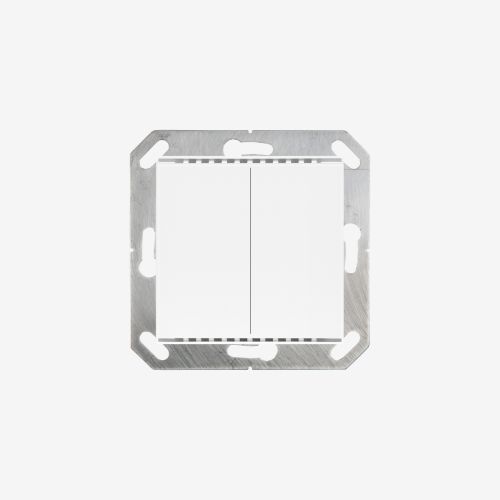
Elsner 70870 double switch pure white RAL9010
| Lieske Part No. | 705316 |
|---|---|
| Mfg Part No | 70870 |
| EAN-Code | 4051996708704 |
| Manufacturer | Elsner |
| Here only | 166,85 EUR
198,55 EUR incl. VAT
|
Further information for Elsner 70870 double switch pure white RAL9010
| General | |
| Housing | real glass, plastic, metal |
| Housing colour (similar) | RAL 9010 (white), RAL 9005 (black) |
| Degree of protection (after installation) | IP20 |
| Dimensions (W × H × D) | 55mm × 55mm × 35mm |
| Mounting ring (W × H) | 71 mm × 71 mm |
| Installation depth | ≈ 7mm |
| Weight total | ≈ 50g |
| Ambient temperature | 5…+45°C |
| Ambient air humidity (rH) (non-condensing) | 0...95% |
| Storage temperature | 25...+70°C |
| Over voltage category | III |
| Pollution degree | 2 |
| KNX bus | |
| Medium | TP1-256 |
| Configuration mode | S-Mode |
| Maximum group addresses | 183 |
| Maximum assignments | 183 |
| Communication object | 55 |
| Nominal voltage | 30V DC SELV |
| Electricity consumption | ≤ 15 mA |
| KNX connector terminals wire diameter stripping length | 0.6…0.8mm s, 5mm |
| Time delay after bus voltage recovery until data reception | ≈ 5s |
| Sensors | |
| Temperature measurement range | 5…+60°C |
Applications
The push-button is intended for installation in indoor environments, where it can be integrated into existing switch rows. It is suitable for controlling lighting, devices, drives, dimmers, as well as for transmitting values and triggering scenes. The integrated temperature measurement enables room temperature detection in the range of 5 to +60 °C. The device can receive external temperature values via the KNX bus and combine them with its own measurement to calculate a mixed value, with the percentage contribution being adjustable. This is particularly useful in systems relying on multiple sensors to ensure accurate room temperature representation.
Functions and Equipment in Detail
The push-button offers two independent touch bus buttons, each configurable as a switch, toggle switch, dimmer, 8- or 16-bit value transmitter, or for scene calls. An additional surface function is activated when both buttons are touched simultaneously and can also be used as a switch, toggle switch, value transmitter, or scene call. The integrated LEDs in the touch surfaces can be individually controlled: they illuminate at an object value of 1, remain off at 0, can illuminate for a user-defined duration after button press, or remain permanently off. Additionally, the LED can flash at a lock object value of 1. Configuration is performed via the KNX software ETS, which enables assignment of group addresses and mappings. Up to 183 group addresses and 183 mappings can be assigned, supporting 55 communication objects.
Technology Explained Simply
The device communicates via the KNX bus medium TP1-256, used for data transmission in the building bus. The configuration mode is S-Mode, meaning settings are made via the ETS software. The nominal voltage is 30 V DC SELV (safe extra-low voltage), with a maximum current consumption of 15 mA. The connection terminals for the KNX bus are designed for conductor diameters of 0.6 to 0.8 mm s, with a stripping length of 5 mm. After bus voltage is restored, it takes approximately 5 seconds for the device to resume data reception. The integrated logic functions include two AND and two OR gates, each with four inputs. Inputs can be switching events or eight logic inputs in the form of communication objects. The output of each gate can be configured as either 1 bit or 2 x 8 bits, enabling flexible signal interconnection.
Compatibility and Accessories
The device is designed for use in KNX systems and requires the use of a compatible frame that matches the switch program used in the building. The device is delivered with a carrier plate and a data sheet including installation instructions (in German, English, French, Italian, Spanish). Additionally, a manual and a product file are available for download.
Installation and Mounting
Installation is carried out in a standard socket with a diameter of 60 mm and a depth of 42 mm. The device is mounted using a carrier plate inserted into the socket. The push-button is then inserted into the carrier and fitted with a frame that matches the existing switch design. Electrical connection is made via the KNX plug terminals, designed for conductor diameters of 0.6 to 0.8 mm s. Configuration is performed via the ETS software, where group addresses, mappings, and logic functions can be individually set.
Operational Advantages
The push-button offers intuitive operation through its touch-sensitive surfaces, which are visually indicated by the integrated LEDs. The ability to integrate and mix external temperature values increases the accuracy of room temperature measurement. The logic functions enable complex control sequences beyond simple switching functions. Configuration via ETS provides flexibility and adaptability to various requirements in building automation systems. The use of real glass and metal ensures a robust and aesthetically pleasing surface that integrates well into modern interior designs. Power supply is via the KNX bus network (30 V DC SELV), eliminating the need for a separate power supply. The maximum current consumption of 15 mA is low and does not significantly burden the bus network.

This is an offer of:
79279 Vörstetten
https://industry-electronics.com
Tel. 07666/88499-0
Fax. 07666/88499-111
Diesen Artikel finden Sie unter:
industry-electronics.com/artikel/705316

Lieske Elektronik e.K.
Reutener Str. 1079279 Vörstetten
https://industry-electronics.com
Tel. 07666/88499-0
Fax. 07666/88499-111
Diesen Artikel finden Sie unter:
industry-electronics.com/artikel/705316