
Elsner 70405 smoke detector KNX basic
Security Technology > Sensors > Motion Detectors
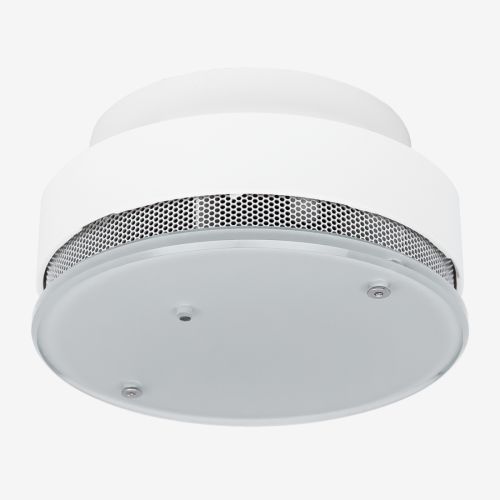
Elsner 70405 smoke detector KNX basic
| Lieske Part No. | 688203 |
|---|---|
| Mfg Part No | 70405 |
| EAN-Code | 4051996704058 |
| Manufacturer | Elsner |
| Here only | 254,67 EUR
303,06 EUR incl. VAT
|
Further information for Elsner 70405 smoke detector KNX basic
| Smoke detector | |
| Detection principle | Tyndall effect (optical) |
| Alarm indication | optical (red LED) and, acoustic (signal tone >85 dB(A) / 3 m) |
| Complied standards | EN 14604:2005 |
| Maximum monitoring area | 60 m² up to 6 m height |
| Air velocity | max. 20 m/s |
| Trigger sensitivity | 0.15 dB/m typical |
| Storage capability of detector | max. 2 years |
| Technical data | |
| Housing | ABS, glass |
| Colour | White / Translucent |
| Mounting | Surface mounted (plaster) |
| Degree of protection | IP 30 |
| Dimensions | Ø ca. 113 mm, height ca. 58 mm |
| Weight | ca. 280 g |
| Ambient temperature | operation -10…+60°C, storage -10°C … +60°C |
| Ambient air humidity | max. 90% rH, avoid condensation |
| Operating voltage | 9 V (battery) |
| Auxiliary voltage | KNX bus voltage |
| Data output | KNX +/- bus terminal |
| Communication objects | Salva KNX TH: 311, Salva KNX basic: 192 |
| Temperature sensor (Salva KNX TH) | |
| Measuring range | 10…+60°C |
Applications
This smoke detector is designed for indoor use, particularly in residential and office buildings where early fire detection is required. It monitors a maximum area of up to 60 m² at room heights of up to 6 m. The operating environment requires temperatures between -10 °C and +60 °C and a maximum relative humidity of 90 % rH, while condensation should be avoided. The device has a storage life of up to 2 years, during which the battery supply remains intact.
Functions and Equipment in Detail
The detector operates based on the Tyndall effect (optical), a scattering light principle that detects smoke particles within the sensing chamber. The typical sensitivity is 0.15 dB/m, enabling high sensitivity for early smoke development. Upon detection, a local alarm is triggered by a red LED and an audible signal with at least 85 dB(A) at a distance of 3 m. Additionally, an alarm message is sent over the KNX bus. Battery capacity depletion is indicated optically and acoustically 30 days before failure and also reported via the bus. An automatic self-test checks the entire electronics and power supply to ensure operational reliability.
Technology Explained Simply
The operating voltage is supplied by a 9-V battery, included in the delivery. The KNX bus voltage is used as auxiliary power to enable network communication. Data output is via a KNX +/- bus terminal block, which integrates into the existing KNX system. Communication objects are defined with 192 for the Salva KNX basic, enabling configuration through the KNX software ETS. The devices support logic functions such as AND and OR gates, as well as multifunction modules for data processing, allowing complex control logics to be implemented.
Compatibility and Accessories
The detector is specifically developed for the KNX system and requires installation within a building bus network. It is compatible with other devices in the Salva KNX series, particularly the Salva KNX TH, which offers additional functions such as temperature and humidity sensing. Configuration is performed via ETS software, where communication objects and logic functions can be individually adjusted. The devices are intended for wall or ceiling mounting, using the included screws and anchors for fastening. The delivery also includes a datasheet with installation instructions and a user manual available for download.
Installation and Mounting
Mounting is surface-mounted, using the provided fastening elements (screws and anchors). Positioning should be chosen to optimally utilize the maximum monitoring area of 60 m² at room heights up to 6 m. Installation requires connection to the KNX bus via the bus terminal block. Configuration is done via ETS software, where communication objects and logic functions are set according to the building’s requirements. Air velocity in the application area should not exceed 20 m/s to avoid false alarms.
Operational Advantages
The Elsner Salva KNX basic provides reliable and early smoke detection with integrated self-monitoring. The combination of local alarm and KNX integration enables central monitoring and control. Battery power ensures independent operation, even during power outages, and the indication of low battery capacity ensures timely maintenance. Integrated logic functions allow flexible use in complex building automation systems. Compliance with the standard EN 14604:2005 ensures conformity with applicable safety requirements for smoke detectors.

This is an offer of:
79279 Vörstetten
https://industry-electronics.com
Tel. 07666/88499-0
Fax. 07666/88499-111
Diesen Artikel finden Sie unter:
industry-electronics.com/artikel/688203

Lieske Elektronik e.K.
Reutener Str. 1079279 Vörstetten
https://industry-electronics.com
Tel. 07666/88499-0
Fax. 07666/88499-111
Diesen Artikel finden Sie unter:
industry-electronics.com/artikel/688203