
Elsner 20550 indoor sensor WGTH-UP white
Installation > Home Automation > EIB material
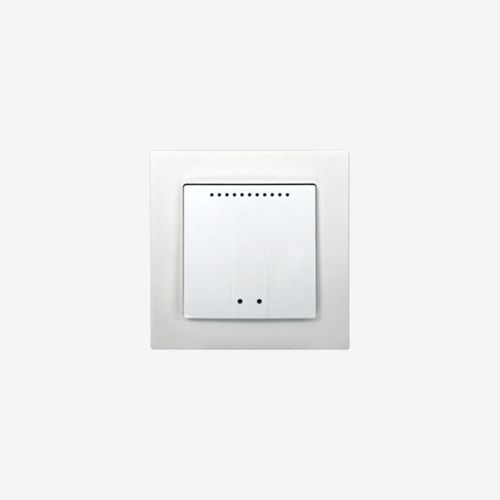
Elsner 20550 indoor sensor WGTH-UP white
| Lieske Part No. | 763467 |
|---|---|
| Mfg Part No | 20550 |
| EAN-Code | 4051996205500 |
| Manufacturer | Elsner |
| Here only | 137,31 EUR
163,40 EUR incl. VAT
|
Further information for Elsner 20550 indoor sensor WGTH-UP white
| General | |
| Housing | Plastic (partially lacquered) |
| Colours [similar] | [RAL 9016], white glossy, aluminium matt |
| Degree of protection | IP20 |
| Housing dimensions (W × H) | 55 mm × 55 mm |
| Installation depth | 15 mm |
| Base plate (W × H) | 71 mm × 71 mm |
| Weight total | ≈ 50 g |
| Ambient temperature | 5…+45°C |
| rF (relative humidity) non-condensing | 0...95 % |
| Storage temperature | 25...+70°C |
| Over voltage category | III |
| Pollution degree | 2 |
| Power supply | |
| Voltage | 11…28 V DC SELV |
| Electricity consumption | ≤ 35 mA |
| Connection rigid/flexible conductors | Ø 0.6...0.8 mm |
| Connection stripping length | 5 mm |
| Sensors | |
| Temperature measurement range | 5…+60°C |
| Humidity measurement range | 0...95 % |
| Wireless | |
| Frequency range | 868.0...868.6 MHz |
| Transmitting power | ≤ 10 mW |
Applications
The sensor is intended for use in indoor environments where continuous monitoring of room temperature and relative humidity is required. It is suitable for integration into heating and ventilation controls, air conditioning systems, or building management systems that respond based on environmental data. The measurement ranges are 5 °C to +60 °C for temperature and 0 % to 95 % rH (non-condensing) for humidity, covering typical applications in residential and office buildings. The operating ambient temperature of the device itself is 5 °C to +45 °C, with storage temperature allowed between 25 °C and +70 °C.
Functions and Equipment in Detail
The sensor features integrated evaluation electronics and a sensor probe with a cable of approximately 3 m length to capture environmental data. Data is transmitted wirelessly in the frequency range of 868.0 to 868.6 MHz, with a maximum transmission power of 10 mW. Power supply is via 11 to 28 V DC SELV, with a maximum current consumption of 35 mA. Connection options are designed for solid and stranded conductors (Ø 0.6 to 0.8 mm) with a stripping length of 5 mm. The carrier plate measures 71 mm × 71 mm, while the housing itself measures 55 mm × 55 mm with a mounting depth of 15 mm. The total weight is approximately 50 g.
Technology Explained Simply
Wireless transmission occurs in the 868 MHz band, a frequency range permitted in Germany for wireless communication in building automation. The low transmission power of ≤ 10 mW is sufficient for indoor use and ensures efficient energy consumption. The SELV (Safety Extra Low Voltage) power supply ensures safe operation without additional protective measures. The sensor probe cable with 3 m length allows flexible positioning of the sensor, with the probe itself placed close to the area to be monitored. The overvoltage category III and pollution degree 2 indicate suitability for normal indoor environments without expected special electrical or mechanical stresses.
Compatibility and Accessories
The sensor is compatible with WS1 Color/Style, WS1000 Color/Style, and KNX WS1000 Color/Style controls (from version 1.0). It can be connected alternatively to a frame from the switch series used in the building to ensure uniform visual design. The delivery includes the evaluation electronics, sensor probe with approx. 3 m cable, and a datasheet with installation instructions in multiple languages (German, English, French, Italian, Spanish).
Mounting and Installation
Mounting is done into a standard device box (Ø 60 mm, 42 mm deep), with the carrier plate (71 mm × 71 mm) inserted into the box. Electrical connections are made via designated terminals for solid and stranded conductors (Ø 0.6–0.8 mm) with a stripping length of 5 mm. Power supply is via the specified voltage (11–28 V DC SELV). Sensor positioning should avoid direct influence from radiators, fans, or other heat sources to ensure accurate measurements. Installation is for indoor use, with ambient temperature between 5 °C and +45 °C.
Operational Advantages
The sensor enables decentralized collection of room climate data, directly fed into control units. Wireless transmission reduces the need for additional cabling and simplifies installation. Low power consumption and SELV supply ensure safe and energy-efficient operation. The option to visually integrate the sensor into existing switch ranges enhances the aesthetics of the installation. The measurement ranges cover typical indoor conditions, making the sensor suitable for a wide range of applications.

This is an offer of:
79279 Vörstetten
https://industry-electronics.com
Tel. 07666/88499-0
Fax. 07666/88499-111
Diesen Artikel finden Sie unter:
industry-electronics.com/artikel/763467

Lieske Elektronik e.K.
Reutener Str. 1079279 Vörstetten
https://industry-electronics.com
Tel. 07666/88499-0
Fax. 07666/88499-111
Diesen Artikel finden Sie unter:
industry-electronics.com/artikel/763467