
Elecfreaks EF04024 Rain/Steam Sensor
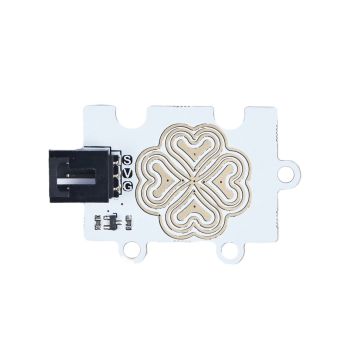
Elecfreaks EF04024 Rain/Steam Sensor
| Lieske Part No. | 823578 |
|---|---|
| Mfg Part No | EF04024 |
| EAN-Code | |
| Manufacturer | Elecfreaks |
| Here only | 1,66 EUR
1,98 EUR incl. VAT
|
Further information for Elecfreaks EF04024 Rain/Steam Sensor
| General | |
| Sensor type | Analog sensor |
| Connection | 3-Pin |
| Connections | Signal, VCC, GND |
| Output signal | Analogue |
| Response time | fast |
| Compatibility | micro:bit, Arduino |
| Application range | Environmental monitoring, Smart Gardening, weather stations |
| Additional function | Touch sensor |
Applications
The sensor is suitable for applications in environmental monitoring, smart gardening, and weather stations. It can, for example, be used to monitor soil moisture in plant cultures or to detect precipitation outdoors. The high sensitivity and fast response time enable precise and timely detection of humidity changes. Additionally, the sensor surface can also be used as a simple touch sensor, increasing the versatility of the module in interactive projects.
Functions and Features in Detail
The sensor surface consists of a material that reacts to moisture and changes its electrical resistance accordingly. This resistance change is converted into an analog voltage signal, which is transmitted to the microcontroller via the Signal connection. The output voltage is proportional to the humidity concentration, allowing for quantitative evaluation of the measured values. The three connections (Signal, VCC, GND) are standardized and compatible with common development environments.
Technology Explained Simply
The sensor operates on the basis of an analog sensor, which does not require digital signal processing but instead delivers a continuous voltage signal. This signal must be converted by the control unit (e.g., Arduino) via an analog-to-digital converter (ADC) into digital values to be processable. The sensitivity of the module is designed to detect even slight changes in humidity. The response time is short, allowing environmental changes to be detected quickly.
Compatibility and Accessories
The sensor is compatible with various microcontrollers, especially micro:bit and Arduino. Connection is made via the three connections (Signal, VCC, GND), with the supply voltage (VCC) being provided by the control unit.
Mounting and Installation
Installation is done by directly connecting the three connections to the corresponding pins on the microcontroller board. No additional components or tools are required. The sensor surface should be freely accessible to ensure uninterrupted humidity detection. When used outdoors, care should be taken to prevent mechanical damage to the sensor surface.
Advantages in Operation
The sensor is characterized by its easy handling, high sensitivity, and fast response time. The plug-and-play functionality reduces the entry barrier for users without in-depth electronics knowledge. Its use in educational projects is particularly advantageous, as the interface is intuitive to understand. The versatility of the module, which can be used both as a humidity sensor and as a touch sensor, increases its utility in various application scenarios.

This is an offer of:
79279 Vörstetten
https://industry-electronics.com
Tel. 07666/88499-0
Fax. 07666/88499-111
Diesen Artikel finden Sie unter:
industry-electronics.com/artikel/823578

Lieske Elektronik e.K.
Reutener Str. 1079279 Vörstetten
https://industry-electronics.com
Tel. 07666/88499-0
Fax. 07666/88499-111
Diesen Artikel finden Sie unter:
industry-electronics.com/artikel/823578