
Moeller 266145 LSM-11/L position switch roller lever
Industrial Material > Control devices / Pilot devices > Limit switches, mechanical
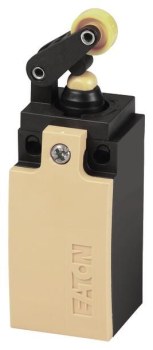
Moeller 266145 LSM-11/L position switch roller lever
| Lieske Part No. | 807508 |
|---|---|
| Mfg Part No | 266145 |
| EAN-Code | 4015082661458 |
| Manufacturer | Eaton |
| Here only | 104,97 EUR
124,91 EUR incl. VAT
|
Further information for Moeller 266145 LSM-11/L position switch roller lever
| General | |
| Degree of protection | IP66, IP67 |
| Ambient temperature | -25 - +70 °C |
| Construction type | EN 50047 Form E |
| Contacts | 1 make contact (NO), 1 breaker contact (NC) |
| Colour of housing cover | Yellow |
| Housing | Metal |
| Connection type | Cage Clamp |
| Type identifier | LS(M)-. |
| Assortment | Roller lever |
| Basic function | Position switch, safety position switch |
| Description | Long |
| Features | Complete device |
| Forced opening | |
Applications
The LSM-11/L is suitable for applications requiring reliable and safe position detection, particularly in environments with high demands on mechanical durability and environmental resistance. Typical applications include the manufacturing industry, packaging and processing technology, as well as systems with moving parts where positioning is critical for operation. The protection rating IP66 and IP67 makes the switch suitable for outdoor use or in damp, dusty environments.
Functions and Equipment in Detail
The switch features one normally closed contact (1 S) and one normally open contact (1 Ö), designed for controlling electrical circuits. The safety function is ensured by forced opening according to IEC/EN 60947-5-1, meaning the contacts will safely open even in case of mechanical failure or damage to the lever. This is crucial for complying with safety standards in machine building and automation technology. The housing cover is yellow, supporting visual identification of the safety function.
Technology Explained Simply
The housing is made of metal, providing high mechanical stability and resistance to external influences. The connection technology uses Cage Clamp, a proven clamping technique that enables a secure and reliable electrical connection without additional tools. The operating ambient temperature range is from -25 °C to +70 °C, making the switch suitable for a wide range of operating conditions. The protection rating IP66 and IP67 guarantees that the switch is dust-tight and protected against water jets and temporary immersion.
Compatibility and Accessories
Various accessories are available to extend functionality and adapt to specific requirements. These include, for example, the EMS20 membrane screw M20, the LS-X20 screw cap transparent M20 IP65, as well as various M12 connectors and sockets, such as the M12A M12 connector M20 IP65 24 V/4 A or the M12B built-in connector M12 B-coded. Additionally, the LS-XAP adapter plate for LS-Titan and the LS-XTW twin opener for LS-Titan are available to facilitate mounting and functional expansion. The FS-AT guide disc for AT... ensures precise guidance of the lever.
Mounting and Installation
Mounting is performed according to the design standard EN 50047 Form E, enabling standardized fixation in control enclosures. The Cage Clamp connection technology allows for quick and secure wiring without additional tools. The switches are designed for industrial environments and do not require special mounting aids. Installation typically involves inserting into pre-drilled mounting openings and connecting the contacts.
Advantages in Operation
The LSM-11/L offers high reliability through the forced opening function, ensuring the switch safely opens even in case of mechanical failure. The metallic housing construction and protection rating IP66/IP67 ensure long service life even under harsh operating conditions. The Cage Clamp technology reduces installation time and increases the safety of the electrical connection. The yellow color of the housing cover supports visual identification of the safety function during operation.

This is an offer of:
79279 Vörstetten
https://industry-electronics.com
Tel. 07666/88499-0
Fax. 07666/88499-111
Diesen Artikel finden Sie unter:
industry-electronics.com/artikel/807508

Lieske Elektronik e.K.
Reutener Str. 1079279 Vörstetten
https://industry-electronics.com
Tel. 07666/88499-0
Fax. 07666/88499-111
Diesen Artikel finden Sie unter:
industry-electronics.com/artikel/807508