
Moeller 215637 EVG-1PHAS/12MODUL Meter Cabinet
Installation > Distributor Cabinets > Meter Cabinets
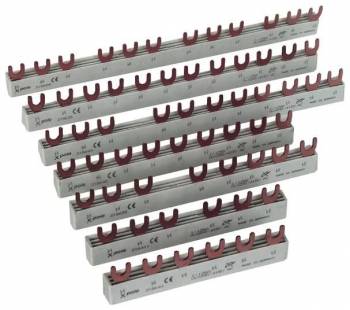
Moeller 215637 EVG-1PHAS/12MODUL Meter Cabinet
| Lieske Part No. | 395597 |
|---|---|
| Mfg Part No | 215637 |
| EAN-Code | 4015082156374 |
| Manufacturer | Eaton |
| Here only | 5,50 EUR
6,55 EUR incl. VAT
|
Further information for Moeller 215637 EVG-1PHAS/12MODUL Meter Cabinet
| Features | |
| Product colour | White |
| Operating voltage | 500 V |
| Number of poles | 1 |
| Connection type | Fork connection |
| Cross-section | 10 mm² |
| Maximum current | 63 A |
| Weight & dimensions | |
| Length | 210 mm |
Applications
The busbar is used in electrical distribution systems, particularly in meter enclosures, where reliable and safe power distribution is required. It is intended for use with the specified switching device series and enables a compact and orderly installation. The design allows for direct mounting without additional end caps, reducing installation time and simplifying the process.
Functions and Equipment in Detail
The fork connection ensures a secure and mechanically stable connection to the switching devices. The connection is designed to provide high electrical conductivity while also offering mechanical strength. The maximum current rating of 63 A is sufficient for most distribution tasks in low- and medium-voltage systems. The operating voltage of 500 V covers the typical range for low-voltage systems. The busbar is designed for 12 module widths, enabling standardisation within distributor boxes. The white colour matches the standard colour for electrical components in distributors and ensures a uniform visual appearance.
Technology Explained Simply
The busbar functions as a central power distribution unit, supplying multiple switching devices with electricity. The fork connection is a proven connection system that ensures a secure and durable electrical connection. The operating voltage of 500 V means the busbar is designed for systems operated up to this voltage. The current rating of 63 A is the maximum load the busbar can transmit continuously without thermal overload or risk to electrical safety. The length of 210 mm corresponds to the standard length for 12 module widths, enabling easy integration into standard distributor boxes.
Compatibility and Accessories
The busbar is specifically developed for use with the switching device series PLS, CLS, PKN, PFIM, PFHM and PFNM. These series are widely used in electrical installations and enable modular and flexible distribution. The busbar requires no end caps, simplifying installation and reducing the number of required components.
Mounting and Installation
Mounting is done by direct installation into the distributor box, where the busbar is secured at the designated mounting points. The fork connection enables a simple and secure connection to the switching devices. Installation is performed without additional end caps, reducing installation time. The busbar is designed for single-pole applications, meaning it is suitable for distributing phase conductors in single-phase systems. Installation is typically carried out by electrical contractors in accordance with applicable regulations and standards.
Operational Advantages
The Euro-Vario busbar provides a standardised and modular solution that simplifies the installation and maintenance of distributors. The fork connection ensures a reliable electrical connection that remains stable even under load. The maximum current rating of 63 A and the operating voltage of 500 V cover most applications in electrical installations. The length of 210 mm corresponds to the standard for 12 module widths, enabling easy integration into existing systems. The elimination of end caps reduces installation time and the number of required components, simplifying maintenance and servicing.

This is an offer of:
79279 Vörstetten
https://industry-electronics.com
Tel. 07666/88499-0
Fax. 07666/88499-111
Diesen Artikel finden Sie unter:
industry-electronics.com/artikel/395597

Lieske Elektronik e.K.
Reutener Str. 1079279 Vörstetten
https://industry-electronics.com
Tel. 07666/88499-0
Fax. 07666/88499-111
Diesen Artikel finden Sie unter:
industry-electronics.com/artikel/395597