
Moeller 153163 gateway EU5C-SWD-EIP-MODTCP EtherNet/IP Modbus-TCP
Industrial Material > Automation > Industrial bus systems
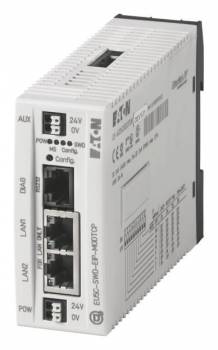
Moeller 153163 gateway EU5C-SWD-EIP-MODTCP EtherNet/IP Modbus-TCP
| Lieske Part No. | 1132631 |
|---|---|
| Mfg Part No | 153163 |
| EAN-Code | 4015081498901 |
| Manufacturer | Eaton |
| Here only | 348,39 EUR
414,58 EUR incl. VAT
|
Further information for Moeller 153163 gateway EU5C-SWD-EIP-MODTCP EtherNet/IP Modbus-TCP
| General | |
| Product type | SmartWire-DT Gateway |
| Compatibility | EtherNet/IP, MODBUS-TCP |
| Number of controllable participants | 99 |
| Ethernet interface | 10/100 MBit/s |
| Operation mode | Slave |
| IP addressing | DIP switch or DHCP |
| Diagnostics interface | Serial |
Applications
This gateway is designed for use in industrial automation systems, particularly in environments where SmartWire-DT networks are used to control switching devices, sensors, and actuators. It is commonly used in the manufacturing industry, machine building, and plants with decentralized periphery, where reliable and simple integration of field devices into existing networks is required. Support for EtherNet/IP and MODBUS-TCP ensures compatibility with a wide range of control systems and PLCs.
Functions and Features in Detail
The device features an integrated Ethernet switch with a data rate of 10/100 MBit/s, operating as a slave in the network. This enables communication with higher-level control systems supporting EtherNet/IP or MODBUS-TCP. The IP address can be set manually via a DIP switch or assigned automatically via DHCP, providing flexible configuration in various network environments. Up to 99 SmartWire-DT participants can be connected to the gateway, enabling broad coverage of decentralized devices in a plant. A separate serial diagnostic interface supports troubleshooting and maintenance by providing direct access to status information and configuration data.
Technology Explained Simply
The SmartWire-DT Gateway acts as a bridge between the SmartWire-DT network and the higher-level fieldbus. It supplies power to connected participants and simultaneously handles data transmission. Communication occurs via the integrated Ethernet switch, which operates as a slave, meaning it responds to requests from a master system. Support for EtherNet/IP and MODBUS-TCP allows integration into various industrial network environments. The IP address can be configured manually via a DIP switch or dynamically via DHCP, simplifying integration into existing networks. The serial diagnostic interface supports local diagnostics and configuration, especially when a network connection is unavailable.
Compatibility and Accessories
The gateway is compatible with SmartWire-DT networks and can support up to 99 participants. It is designed for use with EtherNet/IP- and MODBUS-TCP-based control systems. As accessories, programming cables such as the EU4A-RJ45-USB-CAB1 are available, enabling local configuration and diagnostics. Additionally, Powerfeed modules such as the EU5C-SWD-PF1-1 or Busrefresh modules such as the EU5C-SWD-PF2-1 can be used to optimize power supply or signal quality in the SmartWire-DT network.
Mounting and Installation
Installation typically takes place in an enclosure or control console. The gateway is connected to participants via the SmartWire-DT network and to the higher-level network via an Ethernet cable. IP address configuration is done either via the DIP switch or via DHCP, depending on the network environment. The serial diagnostic interface can be used for local settings or maintenance. No special tools or additional components are required to put the gateway into operation.
Operational Advantages
The gateway simplifies the integration of decentralized SmartWire-DT participants into existing fieldbus systems. Support for EtherNet/IP and MODBUS-TCP ensures broad compatibility with various control systems. The ability to connect up to 99 participants enables an efficient network structure. The serial diagnostic interface provides an additional option for troubleshooting and configuration, simplifying maintenance and commissioning. Flexible IP addressing via DIP switch or DHCP adapts to various network environments.

This is an offer of:
79279 Vörstetten
https://industry-electronics.com
Tel. 07666/88499-0
Fax. 07666/88499-111
Diesen Artikel finden Sie unter:
industry-electronics.com/artikel/1132631

Lieske Elektronik e.K.
Reutener Str. 1079279 Vörstetten
https://industry-electronics.com
Tel. 07666/88499-0
Fax. 07666/88499-111
Diesen Artikel finden Sie unter:
industry-electronics.com/artikel/1132631