
Dold 0069880 RN5893.12/100/61 ACDC24-60V 1K-500K insulation monitor
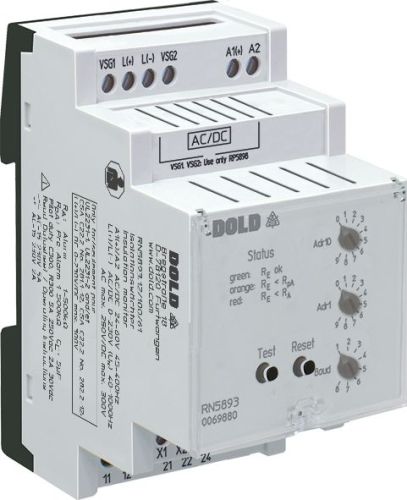
Dold 0069880 RN5893.12/100/61 ACDC24-60V 1K-500K insulation monitor
| Lieske Part No. | 1001706 |
|---|---|
| Mfg Part No | 0069880 |
| EAN-Code | 4030641698805 |
| Manufacturer | Dold |
| Here only | 684,28 EUR
814,29 EUR incl. VAT
|
Further information for Dold 0069880 RN5893.12/100/61 ACDC24-60V 1K-500K insulation monitor
| Technical data | |
| Approvals | UL-Recognized |
| Bus interface | Modbus RTU |
| Classification | For DC charging stations |
| Enclosure design | Distribution board |
| IMD type | AC, AC/DC, DC |
| Nominal voltage IT system | AC 0 - 230 V, AC 0 - 690 (Coupling device) V, DC 0 - 230 V, DC 0 - 1000 (Coupling device) V |
| Response value | 1 - 500 kΩ |
| Response value type | Adjustable |
| Width | 52,5 mm |
| Type | RN 5893/100 |
| Earth fault indicator | |
| Variant | |
| Alarm value | 1 - 500 kOhm |
| Auxiliary voltage | AC/DC 24 - 60 V |
| Contact equipping | 2 x 1 changeover contact |
| Prewarning value | 1 - 500 kOhm |
| Approvals and Markings | UL-rec. C/US |
| Variant | Für Netzableitkapazitäten bis 5 µF |
Applications
The insulation monitor is universally applicable in IT systems with nominal voltages up to AC 230 V or DC 230 V. When used with an external pre-stage device RP 5898, higher voltages up to AC 690 V and DC 1000 V can also be monitored. The device class is designed for network capacitances up to 5 µF, which is sufficient for many industrial and mobile applications. Monitoring is also performed when the network is de-energized, enabling continuous safety even during standby operation.
Functions and Features in Detail
The device features two independently adjustable trip thresholds, which can be used for pre-alarm and alarm functions. The adjustment range for both thresholds is between 1 kΩ and 500 kΩ. The trip values can be parameterized via a Modbus RTU interface, allowing flexible adaptation to the respective installation. The two changeover contacts are galvanically isolated and can be configured for various functions such as insulation fault alarm, pre-alarm, or device fault. The operating or resting current principle for the alarm relays is also adjustable.
Technology Explained Simply
Insulation resistance measurement is performed by evaluating the network voltage, ensuring optimized measurement even under voltage fluctuations. The device's response time is maximum 1 second, enabling rapid fault detection. The measurement circuits L(+) and L(−) are equipped with wire break monitoring, which can optionally be deactivated. The protective earth connections PE1 and PE2 are also monitored for wire break, and this function cannot be deactivated. A manual device self-test is available, and an automatic self-test can be activated. Alarm memory is selectable, allowing faults to be traced even after a reset.
Compatibility and Accessories
The device is equipped with a galvanically isolated Modbus RTU interface, enabling reading and control of all measured values, device states, and parameters. Communication occurs via a serial interface, suitable for integration into higher-level control and monitoring systems. Connection to an external pre-stage device RP 5898 enables use in higher-voltage networks. The width is 52.5 mm, allowing installation in standard installation distributors.
Mounting and Installation
The auxiliary voltage is supplied via terminals A1(+) and A2 and can range from AC/DC 24 to 60 V. Power supply is via a wide voltage input range, allowing flexible adaptation to various network voltages. Mounting is done in an installation distributor, with a tamper-proof transparent cover protecting against unauthorized manipulation. The multi-colored device status LED visually indicates the operating status in a user-friendly manner.
Advantages in Operation
The insulation monitor offers an extended operating temperature range from −40 °C to +70 °C, making it suitable for use in extreme environments. The combination of fast response time, flexible parameterization via Modbus, and the ability to monitor even when the network is de-energized ensures reliable and continuous safety function. Galvanic isolation of contacts and integrated wire break monitoring increase system reliability. The UL-Recognized C/US certification enables use in corresponding markets.

This is an offer of:
79279 Vörstetten
https://industry-electronics.com
Tel. 07666/88499-0
Fax. 07666/88499-111
Diesen Artikel finden Sie unter:
industry-electronics.com/artikel/1001706

Lieske Elektronik e.K.
Reutener Str. 1079279 Vörstetten
https://industry-electronics.com
Tel. 07666/88499-0
Fax. 07666/88499-111
Diesen Artikel finden Sie unter:
industry-electronics.com/artikel/1001706