
Dold 0069301 voltage relay RN9854.11 AC150-528V 4-20% 0-30S
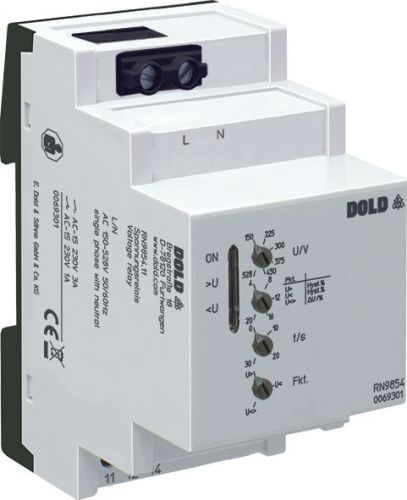
Dold 0069301 voltage relay RN9854.11 AC150-528V 4-20% 0-30S
| Lieske Part No. | 1002201 |
|---|---|
| Mfg Part No | 0069301 |
| EAN-Code | 4030641693015 |
| Manufacturer | Dold |
| Here only | 162,72 EUR
193,64 EUR incl. VAT
|
Further information for Dold 0069301 voltage relay RN9854.11 AC150-528V 4-20% 0-30S
| Technical data | |
| 1- / 3-phase | 1 |
| Auxiliary voltage | Without |
| Enclosure design | Distribution board |
| Nominal voltage max. | AC 528 V |
| Output contacts | 1 C/O contact |
| Width | 52,5 mm |
| Type | RN 9854 |
| Operate delay | |
| Variant | |
| Contact equipping | 1 changeover contact |
| Hysteresis | 4 - 20 % |
| Operating voltage | AC 150 - 528 V |
| Switching delay | 0 - 30 s |
| Variant | De-Energized on trip |
Applications
This relay is suitable for monitoring AC power networks in industrial and technical installations, particularly in systems requiring stable voltage supply. Typical applications include monitoring power supplies in production plants, automatic switching to a safety power supply in case of voltage faults, or integration into monitoring systems for preventive maintenance. The adjustable switching voltage allows application-specific adaptation, while the adjustable hysteresis (4–20 %) ensures the relay does not switch undesirably due to minor voltage fluctuations. The switching delay of 0 to 30 seconds prevents false alarms caused by short-term voltage fluctuations.
Functions and Equipment in Detail
The device features a single-pole changeover output with contact material made of AgNi, designed for high switching capacity and long service life. The switching voltage is AC 250 V, and the thermal current rating is 5 A. The electrical life expectancy is typically 300,000 switching cycles at 1 A and AC 230 V. The mechanical life expectancy is stated to be over 30 million switching cycles. Indication is provided via LEDs: a green LED “ON” indicates that the operating voltage is present, a red LED “>U” signals overvoltage, and a red LED “<U” indicates undervoltage. For voltage range monitoring, the range U ± ρU in percent is adjustable, with the hysteresis for returning to the normal state being half of the set ρU value.
Technology Explained Simply
Measurement is performed directly on the network, with the operating voltage drawn from the monitored system. The network frequency ranges from 45 to 65 Hz, with a nominal frequency of 50/60 Hz. The nominal power consumption of the device is approximately 7 VA. The response delay is activated, meaning the relay does not react immediately upon detecting a voltage deviation, but only after the set delay time (0–30 s) has elapsed. This prevents false alarms caused by short-term voltage fluctuations. The device complies with IEC/EN 60255-1 and is designed for use in single-phase systems.
Compatibility and Accessories
The relay is designed for mounting in installation distributors and has a width of 52.5 mm. It is equipped with a function selector switch that allows selection between overvoltage, undervoltage, and voltage range monitoring. The connection terminals are designed for connecting phase voltage (L), neutral conductor (N), and the changeover contacts (11, 12, 14).
Mounting and Installation
Mounting is performed in an installation distributor, taking into account the width of 52.5 mm. The connection terminals are clearly labeled: L for phase voltage, N for neutral conductor, and 11, 12, 14 for the changeover contacts. Settings for switching voltage, hysteresis, and switching delay are adjusted via rotary controls directly accessible on the device. Functions are selected via a function selector switch that can be switched between the modes “U>” (overvoltage), “U<” (undervoltage), and “U<>” (voltage range).
Operational Advantages
By detecting voltage deviations early, the relay enables preventive maintenance and prevents costly damage to connected devices. High repeatability and a wide measurement voltage range ensure reliable monitoring. Simple adjustment without menu structures reduces installation and maintenance time. Operational safety is enhanced by direct network supply without auxiliary voltage, simplifying installation and reducing the number of required connections. LED indicators provide clear visual feedback on the device’s operating status.

This is an offer of:
79279 Vörstetten
https://industry-electronics.com
Tel. 07666/88499-0
Fax. 07666/88499-111
Diesen Artikel finden Sie unter:
industry-electronics.com/artikel/1002201

Lieske Elektronik e.K.
Reutener Str. 1079279 Vörstetten
https://industry-electronics.com
Tel. 07666/88499-0
Fax. 07666/88499-111
Diesen Artikel finden Sie unter:
industry-electronics.com/artikel/1002201