
Dold 0069154 insulation monitor DC24V 1k-250k
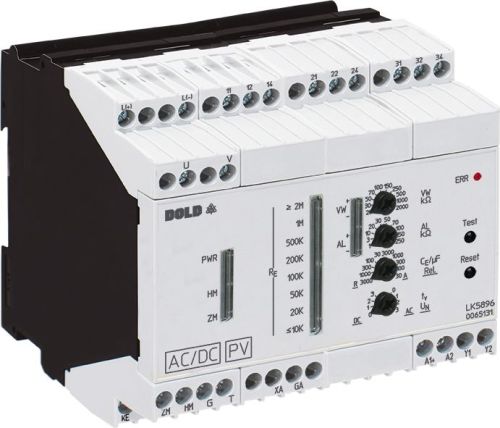
Dold 0069154 insulation monitor DC24V 1k-250k
| Lieske Part No. | 1001673 |
|---|---|
| Mfg Part No | 0069154 |
| EAN-Code | 4030641691547 |
| Manufacturer | Dold |
| Here only | 2.593,37 EUR
3.086,11 EUR incl. VAT
|
Further information for Dold 0069154 insulation monitor DC24V 1k-250k
| Technical data | |
| Approvals | UL |
| Classification | For photovoltaic systems |
| Enclosure design | Switch cabinet |
| IMD type | AC, AC/DC, DC |
| Nominal voltage IT system | AC 0 - 1000 V, DC 0 - 1000 V |
| Response value | 1 - 250 kΩ |
| Response value type | Adjustable |
| Width | 90 mm |
| Type | LK 5896 |
| Connection for indicator | |
| Earth fault indicator | |
| Variant | |
| Alarm value | 1 - 250 kOhm |
| Auxiliary voltage | DC 24 V |
| Contact equipping | 3 x 1 changeover contact |
| Prewarning value | 20 kOhm - 2 MOhm |
| Approvals and Markings | UL-listed C/US, UKCA |
| Variant | With wire-break detection at L(+)/L(-). Analogue output with linear output function to indicate the insulation resistance value. With adapted measurement algorithm. With auxiliary measuring circuit |
Applications
The device is universally applicable in various application areas, including photovoltaic systems, UPS systems, networks with frequency converters, battery networks, DC drives, and in hybrid and battery-powered vehicles. It is specifically designed for IT systems with high network capacitance up to 3000 μF, making it suitable for modern, high-performance systems. Monitoring also occurs when the network is de-energized, ensuring continuous safety even in standby mode. Integrated wire break detection at connections L(+) and L(−) ensures that any interruption in the measurement circuit is detected and reported, preventing false alarms.
Functions and Equipment in Detail
The insulation monitor features three changeover contacts: one for pre-alarm, one for alarm, and a third for signaling wire break and device faults. The pre-alarm threshold is adjustable between 20 kΩ and 2 MΩ, while the alarm value ranges from 1 kΩ to 250 kΩ. Settings are adjusted via rotary switches, with the maximum permissible network capacitance also being adjustable to optimize response time. An integrated self-test can be performed automatically or manually to verify device functionality. Alarm memory is selectable, so an alarm remains stored even after resetting the device. External test and reset buttons can be connected to facilitate operation during runtime.
Technology Explained Simply
Insulation monitoring is performed according to IEC/EN 61557-8, ensuring reliability and compatibility with international standards. The device operates with an adapted measurement algorithm that optimizes measurement times and is typically shorter than conventional methods. An additional measurement circuit enables monitoring of AC outputs, such as from inverters, even when they are switched off. This is particularly important in applications like hybrid vehicles, where safety must be ensured even in standby mode. The auxiliary voltage is DC 24 V, representing a standard supply in industrial and industrial installations. The width is 90 mm, allowing mounting in standard enclosures.
Compatibility and Accessories
The device is designed for IT systems with AC, DC, and AC/DC networks and can be used in systems with high capacitance. Measurement circuits can be deactivated via control terminals, which is advantageous for network connections or integration into larger systems. The analog output provides a linear output signal in the range 0 ... 10 V or 0 ... 20 mA (with bridged XA/GA: 2 ... 10 V / 4 ... 20 mA), which can be connected to higher-level controls, PLCs, or external display units. This enables integration into higher-level monitoring systems. The certifications UL-listed C/US and UKCA confirm compliance with relevant safety and quality standards.
Mounting and Installation
Mounting is done in an enclosure, with the 90 mm width enabling standard installation. Connections are clearly labeled: L(+) and L(−) for the main measurement circuit, U and V for the additional measurement circuit, KE and PE for the protective conductor. Control terminals G, R, T, HM, and ZM allow configuration of memory behavior, external test input, deactivation of measurement circuits, and other functions. Connection options for the analog output (XA, GA, IA, UA) and alarm trigger output (Y1, Y2) are also clearly defined. The device front includes all necessary controls and indicators, enabling installation and commissioning without additional tools.
Advantages in Operation
Operation of the insulation monitor LK 5896 is characterized by simple adjustment and clear display of measured values and statuses. Selective earth fault detection according to L(+) and L(−) enables quick fault localization, reducing maintenance time. Monitoring even when the network is de-energized increases safety, especially in installations that are not permanently energized. Integration into higher-level controls via the analog output enables centralized monitoring and documentation. Wire break detection and the ability to deactivate measurement circuits increase the reliability and flexibility of the device. The UL and UKCA certifications guarantee compliance with international safety standards, which is important for use in various markets.

This is an offer of:
79279 Vörstetten
https://industry-electronics.com
Tel. 07666/88499-0
Fax. 07666/88499-111
Diesen Artikel finden Sie unter:
industry-electronics.com/artikel/1001673

Lieske Elektronik e.K.
Reutener Str. 1079279 Vörstetten
https://industry-electronics.com
Tel. 07666/88499-0
Fax. 07666/88499-111
Diesen Artikel finden Sie unter:
industry-electronics.com/artikel/1001673