
Dold 0069129 UF6925.03/021/61 DC8-36V emergency stop module
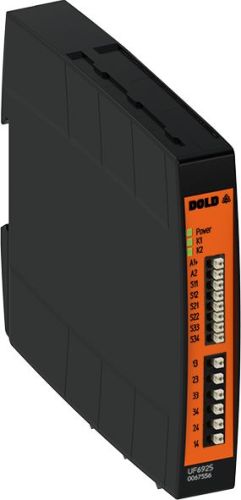
Dold 0069129 UF6925.03/021/61 DC8-36V emergency stop module
| Lieske Part No. | 1002044 |
|---|---|
| Mfg Part No | 0069129 |
| EAN-Code | 4030641691295 |
| Manufacturer | Dold |
| Here only | 228,96 EUR
272,46 EUR incl. VAT
|
Further information for Dold 0069129 UF6925.03/021/61 DC8-36V emergency stop module
| Technical data | |
| 1- / 2-channel | 2 |
| Approvals | UL |
| Cat. / PL acc. to EN ISO 13849-1 | 4/e |
| Connection | Front side cage clamp terminals |
| Output contacts max. | 3 NO contacts |
| SIL CL acc. to IEC/EN 62061 | 3 |
| SIL acc. to IEC/EN 62061 | 3 |
| Thermal current Ith max. | 8 A |
| Width | 17,5 mm |
| Type | UF 6925 |
| Cross fault detection | |
| Suited as safety gate monitor | |
| Variant | |
| Contact equipping | 3 NO contacts |
| Nominal voltage | DC 8 - 36 V |
| Approvals and Markings | UL-listed C/US, TÜV |
| Variant | Switching capacity standard. Start-Mode manual-start. Without cross fault detection |
Applications
This module is intended for use in safety-relevant systems, particularly in automation technology, machines with safety doors, and systems operated in accordance with EN 61511 or EN 50156-1 for combustion systems. It can be used as a safety door monitor to ensure that the machine can only be started when the safety door is properly closed. The application is in industrial environments where reliable and safe shutdown is required in the event of a fault.
Functions and Equipment in Detail
The emergency stop module features a 2-channel design with forced-guided output contacts, each configured as a normally open (NO) contact. The contact configuration includes a total of three NO contacts, connected via front-mounted spring-cage terminals. The operating voltage range is DC 8 to 36 V. The maximum thermal current rating is 8 A. Device indicators include LEDs for Channel 1, Channel 2, and power supply, which visually indicate the operating status. The start function can be initiated manually via the start button, or automatically via switch S2. Cross-short detection at the start button is activated, meaning that a short circuit in the control circuit is detected and signaled.
Technology Explained Simply
The safety function of the module is based on a two-channel, forced-guided relay principle, ensuring that both channels switch simultaneously and synchronously. This increases reliability and prevents one channel from accidentally opening while the other remains closed. Cross-short detection checks the integrity of the control circuit and detects if a wire between contacts is broken or shorted. The LED indicators provide visual monitoring of the operating status and enable quick fault diagnosis. The front-mounted spring-cage terminals simplify installation and maintenance, as no additional tools are required.
Compatibility and Accessories
The module is designed for use with emergency stop buttons and safety doors. It can be integrated into systems operated in accordance with EN 61511 or EN 50156-1. Certifications include UL-listed C/US and TÜV, confirming suitability for use in various markets. The devices are designed for industrial environments and meet the requirements for safety functions up to PL e / Cat. 4 and SIL 3.
Mounting and Installation
Mounting is performed in standard control panels with a module width of 17.5 mm. The connection terminals are arranged on the front, enabling easy and quick wiring. The devices are designed for use in industrial systems and require no special mounting conditions. Installation is carried out according to the manufacturer’s technical instructions.
Advantages in Operation
The emergency stop module provides high safety performance by meeting the requirements for PL e / Cat. 4 and SIL 3. The compact design and front-mounted spring-cage terminals simplify mounting and maintenance. The LED indicators enable quick visual monitoring of the operating status. Cross-short detection increases system reliability by detecting faults in the control circuit. The option to choose between manual and automatic start provides flexibility when integrating into various system configurations.

This is an offer of:
79279 Vörstetten
https://industry-electronics.com
Tel. 07666/88499-0
Fax. 07666/88499-111
Diesen Artikel finden Sie unter:
industry-electronics.com/artikel/1002044

Lieske Elektronik e.K.
Reutener Str. 1079279 Vörstetten
https://industry-electronics.com
Tel. 07666/88499-0
Fax. 07666/88499-111
Diesen Artikel finden Sie unter:
industry-electronics.com/artikel/1002044