
Dold 0069092 RL9405 3/N AC80-230V 50Hz energy meter
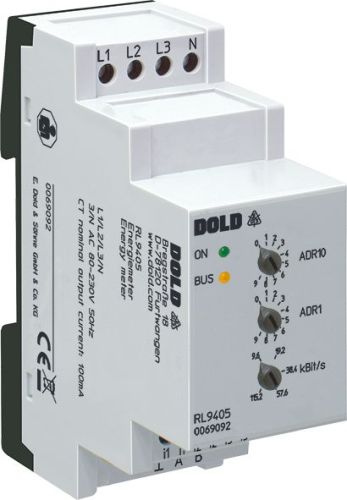
Dold 0069092 RL9405 3/N AC80-230V 50Hz energy meter
| Lieske Part No. | 1000976 |
|---|---|
| Mfg Part No | 0069092 |
| EAN-Code | 4030641690922 |
| Manufacturer | Dold |
| Here only | 360,52 EUR
429,02 EUR incl. VAT
|
Further information for Dold 0069092 RL9405 3/N AC80-230V 50Hz energy meter
| Technical data | |
| 1- / 3-phase | 3 |
| Auxiliary voltage | Without |
| Bus interface | Modbus RTU |
| Enclosure design | Distribution board |
| Measuring range max. | 230 V |
| Standard measuring range | 3/N AC 80 - 230 V |
| Width | 35 mm |
| Type | RL 9405 |
| Variant | |
| Nominal voltage | 3/N AC 80 - 230 V / 140 - 400 V 50 Hz |
| Variant | Secondary rated current of the current transformers 100 mA |
Applications
The RL 9405 is intended for use in 3-phase networks with neutral conductor (IT-, TN- or TT-systems). It is suitable for monitoring energy consumption in production plants, lighting systems, air conditioning systems, or other electrical loads where accurate measurement of electrical parameters is required. The measured values are continuously sampled and evaluated, and the values remain stored in the device after switching off the supply voltage. This ensures continuous data recording even during short-term power outages.
Functions and equipment in detail
The device measures RMS and peak values of phase voltage and phase current, as well as network frequency, power factor, active power, reactive power, apparent power, active energy, reactive energy, and apparent energy. The measurement accuracy is ± 0.5 %. Current measurement is performed via external current transformers, designed for secondary rated currents of 100 mA, 1 A, or 5 A, and a secondary rated voltage of 333 mV. The turns ratio of the current transformers can be set via the Modbus RTU interface, enabling adaptation to market-standard transformers. The measurement ranges extend up to 1000 A when using external current transformers.
Technology explained simply
The device is powered from the measurement voltage of all three phases, eliminating the need for a separate auxiliary power supply. The RS485 interface operates with the Modbus RTU protocol and is galvanically isolated, enabling secure data transmission even in electrically noisy environments. The Modbus address can be set between 1 and 99, and the baud rate is selectable in values of 9600, 19200, and 38400. Display is via two LEDs: a green LED (ON) lights up when operating voltage is present, and a yellow LED (BUS) indicates RS485 bus activity.
Compatibility and accessories
The RL 9405 is designed for use with current transformers having the specified secondary rated values (100 mA, 1 A, 5 A, or 333 mV). Adjustment of the turns ratio is performed via the Modbus interface, allowing the use of a wide range of market-standard current transformers. Communication takes place via a galvanically isolated RS485 interface, suitable for integration into higher-level control or monitoring systems.
Mounting and installation
The device is installed in enclosures or installation small distributors. Mounting is done on a standard 35 mm DIN rail. The terminals are clearly labeled: L1, L2, L3, N for voltage input connections, i1, k1, i2, k2, i3, k3 for current input connections, and GND, A, B for the RS485 interface. Installation is carried out without requiring additional auxiliary power supply.
Advantages in operation
The compact design with a width of 35 mm saves valuable space in the enclosure. Permanent storage of energy measurement values in the device ensures uninterrupted data recording, even during short-term power outages. The galvanically isolated Modbus RTU interface enables robust and interference-free communication. Setting the Modbus address and baud rate is done directly on the device, simplifying configuration. The device is not approved for billing purposes according to EU Directive 2004/22/EC (MID) and therefore must not be used as an electricity meter for active energy consumption.

This is an offer of:
79279 Vörstetten
https://industry-electronics.com
Tel. 07666/88499-0
Fax. 07666/88499-111
Diesen Artikel finden Sie unter:
industry-electronics.com/artikel/1000976

Lieske Elektronik e.K.
Reutener Str. 1079279 Vörstetten
https://industry-electronics.com
Tel. 07666/88499-0
Fax. 07666/88499-111
Diesen Artikel finden Sie unter:
industry-electronics.com/artikel/1000976