
Dold 0069087 RL5881.11 AC/DC24-240V 1K-300K insulation monitor
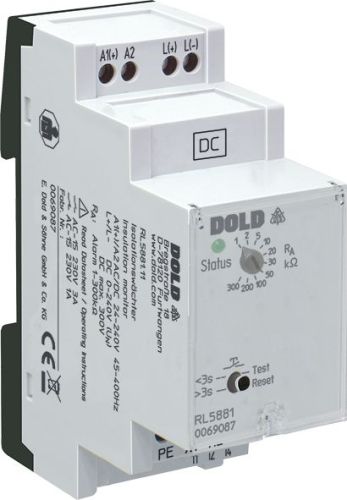
Dold 0069087 RL5881.11 AC/DC24-240V 1K-300K insulation monitor
| Lieske Part No. | 1001666 |
|---|---|
| Mfg Part No | 0069087 |
| EAN-Code | 4030641690878 |
| Manufacturer | Dold |
| Here only | 329,59 EUR
392,21 EUR incl. VAT
|
Further information for Dold 0069087 RL5881.11 AC/DC24-240V 1K-300K insulation monitor
| Technical data | |
| Enclosure design | Distribution board |
| IMD type | DC |
| Nominal voltage IT system | DC 0 - 240 V |
| Response value | 1 - 300 kΩ |
| Response value type | Adjustable |
| Width | 35 mm |
| Type | RL 5881 |
| Earth fault indicator | |
| Variant | |
| Alarm value | 1 - 300 kOhm |
| Auxiliary voltage | AC/DC 24 - 240 V |
| Contact equipping | 1 changeover contact for warning |
Insulation monitoring is carried out in accordance with standard IEC/EN 61557-8, ensuring compliance with international standards for electrical safety. The trip threshold is adjustable in the range of 1 kΩ to 300 kΩ and can be easily and user-friendly adjusted via a rotary switch on the device front. This allows flexible adaptation to the specific requirements of the respective system. Adjustment is performed directly on the device, without additional tools or software.
Functions and equipment in detail include a changeover contact (contact configuration: 1 changeover contact) for alarm signaling, operating on the de-energized-on-trip principle – meaning the alarm relay de-energizes when the trip threshold is reached. This is a common and safe configuration used in many industrial applications. Status indication is provided by a multicolored LED, visually signaling different operating states: green for normal operation, red for insulation fault, and orange for internal device failure. LED blink codes support quick diagnosis of faults.
Technology explained simply shows that the device features an internal self-test that runs for approximately 10 to 12 seconds after the auxiliary voltage is applied. This test checks the device's functionality and is visualized via the LED. After completion of the test, continuous insulation measurement begins. Measurement also occurs when the network is de-energized, which is a special safety feature, as faults can be detected even in stationary systems. The auxiliary voltage can be supplied in the range AC/DC 24 to 240 V, making the device suitable for various industrial environments. The width is 35 mm, enabling standard mounting in installation distributors.
Compatibility and accessories refers to use in DC-IT systems with network capacitances up to 30 μF. The device is designed for monitoring both symmetrical and asymmetrical insulation faults. The memory function for insulation fault alarms is programmable via a control input (X2/X3): if memory is active, the alarm remains stored even if the insulation resistance later returns to the acceptable range. A reset is performed by pressing the Test/Reset button on the front for more than 3 seconds, provided the insulation resistance is again within the acceptable range. The tamper-proof transparent cover provides protection against unauthorized manipulation.
Mounting and installation is carried out in standard installation distributors with a width of 35 mm. Connections are made via terminals L+, L-, and PE, with auxiliary voltage supplied via A1(+) and A2. The device front is designed for operation and maintenance, featuring visible indicators and a simple adjustment mechanism. Mounting requires no additional pre-control devices, simplifying installation.
Advantages in operation include reliable, continuous monitoring, simple operation, and high flexibility due to the adjustable trip threshold. Visual indication and self-test functions increase operational safety. The device is designed for use in industrial and technical installations, where early detection of insulation faults is critical for safety. Compliance with standard IEC/EN 61557-8 ensures the quality and reliability of the product.

This is an offer of:
79279 Vörstetten
https://industry-electronics.com
Tel. 07666/88499-0
Fax. 07666/88499-111
Diesen Artikel finden Sie unter:
industry-electronics.com/artikel/1001666

Lieske Elektronik e.K.
Reutener Str. 1079279 Vörstetten
https://industry-electronics.com
Tel. 07666/88499-0
Fax. 07666/88499-111
Diesen Artikel finden Sie unter:
industry-electronics.com/artikel/1001666