
Dold 0068838 insulation monitor DC24V 1k-250k
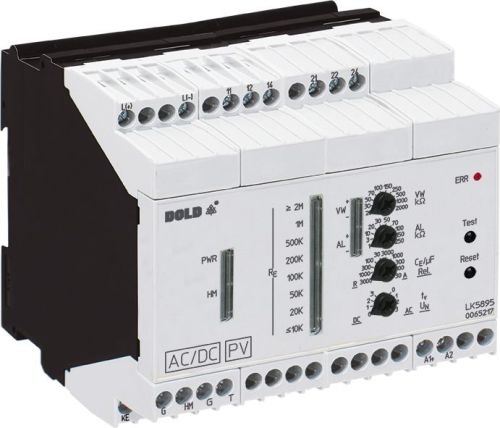
Dold 0068838 insulation monitor DC24V 1k-250k
| Lieske Part No. | 1001671 |
|---|---|
| Mfg Part No | 0068838 |
| EAN-Code | 4030641688387 |
| Manufacturer | Dold |
| Here only | 2.034,88 EUR
2.421,51 EUR incl. VAT
|
Further information for Dold 0068838 insulation monitor DC24V 1k-250k
| Technical data | |
| Approvals | UL |
| Classification | For photovoltaic systems |
| Enclosure design | Switch cabinet |
| IMD type | AC, AC/DC, DC |
| Nominal voltage IT system | AC 0 - 1000 V, DC 0 - 1000 V |
| Response value | 1 - 250 kΩ |
| Response value type | Adjustable |
| Width | 90 mm |
| Type | LK 5895 |
| Earth fault indicator | |
| Variant | |
| Alarm value | 1 - 250 kOhm |
| Auxiliary voltage | DC 24 V |
| Contact equipping | 2 x 1 changeover contact |
| Prewarning value | 20 kOhm - 2 MOhm |
| Approvals and Markings | UL-listed C/US, UKCA |
| Variant | With wire-break detection at L(+)/L(-). Without analog output. With adapted measurement algorithm |
Applications
The insulation monitor is universally applicable in IT systems with a rated voltage up to 1000 V AC or DC. It is suitable for networks with high leakage capacitances up to 3000 μF, making it particularly appropriate for modern installations with large capacitors or power electronics. Applications range from industrial systems and power supply systems to hybrid and battery-powered vehicles. The detection of symmetrical and asymmetrical insulation faults enables precise fault localization.
Functions and Equipment in Detail
The device features two adjustable threshold values: the alarm threshold in the range of 1 kΩ to 250 kΩ and the pre-alarm threshold from 20 kΩ to 2 MΩ. Adjustment is performed via two ratchet rotary switches on the front of the device, which can be operated with a screwdriver. The current insulation resistance is displayed via an LED bar, visually indicating the status. Additionally, an LED labeled PWR" lights up when supplied with DC auxiliary voltage. The "Measurement circuit active indicator signals the operation of the measurement circuit.
Technology Explained Simply
The insulation monitor operates according to the principle of insulation monitoring in accordance with IEC/EN 61557-8. It monitors the measurement circuit between L(+) and L(-) and detects a wire break in the measurement circuit to avoid false alarms. Measurement is also performed when the network is de-energized, enabling continuous monitoring even during standstill phases. Measurement times are optimized and are typically shorter than with conventional methods. An automatic and manual self-test checks the functionality of the device. The output relays operate on either the operating or resting current principle, with the setting being selectable.
Compatibility and Accessories
The device is designed for IT systems with AC, DC, and AC/DC networks. It is classified for use in photovoltaic systems and can be used in networks with frequency converters, battery networks, and DC drives. The control terminals allow deactivation of the measurement circuit, for example, during network coupling. External test and reset buttons can be connected to control the functions externally. Alarm memory is selectable, and the device can be operated with memory behavior or hysteresis behavior.
Mounting and Installation
The device is designed for installation in enclosures and has a width of 90 mm. The connections are clearly labeled: A1+ and A2 for DC auxiliary voltage, L(+) and L(-) for the measurement circuit, KE and PE for the protective conductor, and control terminals G, R, T, and HM for functions such as memory/hysteresis behavior, external test, and measurement circuit deactivation. The relay contacts for alarm (11-14) and pre-alarm (21-24) are each configured as 1 changeover contact.
Operational Advantages
Selective earth fault detection according to L(+) and L(-) enables rapid fault localization. Simple adjustment via rotary switches and visual indication via LEDs facilitate operation. Monitoring even when the network is de-energized and wire break detection in the measurement circuit increase reliability. The device requires no additional pre-stage device, simplifying installation. The certifications UL-listed C/US and UKCA confirm compliance with relevant standards.
Approvals and Markings
The device is UL-listed C/US and UKCA-certified. The approval according to IEC/EN 61557-8 ensures compliance with standards for insulation monitoring. Classification for photovoltaic systems demonstrates specific suitability for solar energy installations.
Enclosure Design and Operation
The device is designed for enclosure mounting and is intended for use in industrial environments. The auxiliary voltage is DC 24 V. Measurement is independent of the main network operation, enabling continuous monitoring. Integrated wire break detection at L(+) and L(-) prevents false alarms in case of interruptions in the measurement circuit.
Display and Status Monitoring
The LED bar displays the current insulation resistance, with the colors of the LEDs visually indicating the status. The Measurement circuit active" indicator signals that measurement is in progress. An internal self-test is performed for 10 seconds after auxiliary voltage is applied to check functionality. The "PWR indicator confirms supply with auxiliary voltage.
Control and Operating Modes
The control terminals allow selection between memory behavior (G/R not bridged) and hysteresis behavior (G/R bridged). Deactivation of the measurement circuit is possible via terminals G/HM. External test and reset buttons can be connected to control the functions externally. Selectable alarm memory allows the operating mode to be adapted to the requirements of the installation.
Use in Photovoltaic Systems
The device is specifically designed for monitoring photovoltaic systems, including those with thin-film technology. Its ability to handle large network leakage capacitances up to 3000 μF makes it suitable for modern PV systems with high capacitances. Detection of earth faults in DC networks is critical for the safety and reliability of such systems.

This is an offer of:
79279 Vörstetten
https://industry-electronics.com
Tel. 07666/88499-0
Fax. 07666/88499-111
Diesen Artikel finden Sie unter:
industry-electronics.com/artikel/1001671

Lieske Elektronik e.K.
Reutener Str. 1079279 Vörstetten
https://industry-electronics.com
Tel. 07666/88499-0
Fax. 07666/88499-111
Diesen Artikel finden Sie unter:
industry-electronics.com/artikel/1001671