
Dold 0068613 ND5014/080 current transformer
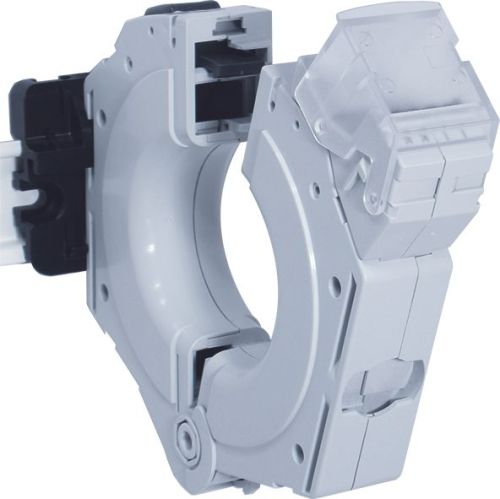
Dold 0068613 ND5014/080 current transformer
| Lieske Part No. | 1001750 |
|---|---|
| Mfg Part No | 0068613 |
| EAN-Code | 4030641686130 |
| Manufacturer | Dold |
| Here only | 526,36 EUR
626,37 EUR incl. VAT
|
Further information for Dold 0068613 ND5014/080 current transformer
| Technical data | |
| Diameter | 49 mm, 79 mm, 119 mm |
| For relay type | IL 5882, SL 5882 |
| Type | ND 5014 |
| Variant | |
| Variant | 79 mm inner diameter |
Applications
The ND5014/080 is primarily used in industrial and commercial electrical engineering, where precise fault current monitoring is required. It is part of an electrical safety system that enables the detection of leakage currents, which may indicate insulation faults or other disturbances in the circuit. The application typically involves use with differential current monitors, which evaluate the measured currents and trigger a shutdown or alarm if a predefined threshold is exceeded.
Functions and Equipment in Detail
The transformer features a passage opening with an inner diameter of 79 mm, making it suitable for conductors with corresponding cross-sections. Installation is carried out on a DIN rail, with both vertical and horizontal mounting options available. The connection terminals are designed as spring clamp connections (Push-In technology), enabling quick and secure wiring. The stripping length is 6 mm, and the permissible conductor cross-sections range from 0.2 mm² to 2.5 mm², for both rigid and flexible conductors. The maximum actuation force is 40 N.
Technology Explained Simply
The hinged current transformer operates on the principle of inductive current measurement. It detects the magnetic flux generated by the current-carrying conductor and converts it into a proportional electrical signal. The nominal transformation ratio is 500:1, meaning that a primary current of 10 A is measured as 20 mA on the secondary side. The accuracy class is 3, which is sufficient for applications in monitoring systems. The insulation coordination corresponds to IEC 61869-1, and the highest operating voltage is AC 720 V. The rated impulse voltage is specified as 8 kV, and the pollution degree is 3.
Compatibility and Accessories
The ND5014/080 is exclusively intended for use with the DOLD differential current monitors IL 5882 and SL 5882. The connection is made via the terminals marked i and k, with two terminals available for each. The technical standards IEC 61869-1 and IEC 61869-8, as well as IEC/EN 62020 for all-current-sensitive Type A monitoring, are fulfilled. The operating ambient temperature range is between -40 °C and +80 °C. The flammability class is V0 according to UL94.
Mounting and Installation
Mounting is performed on a DIN rail, with the transformer secured to an included plinth. The hinged cover protects the terminal block and prevents accidental disconnection of the wiring. During installation, care must be taken to ensure that the conductor passes freely through the transformer and is not subjected to stress during operation. The mounting feet are intended solely for securing the transformer and are not designed to absorb forces from the conductor passing through. Screw mounting is only provided for the ND5014/120 variant, not for the ND5014/080.
Advantages in Operation
The ND5014/080 offers simple and quick installation, especially for retrofits, as no conductors need to be cut. The Push-In technology enables a secure and reliable connection. Compliance with the standards IEC 61869-1, IEC 61869-8, and IEC/EN 62020 ensures reliability and safety in operation. The robust construction and high temperature resistance make the transformer suitable for industrial applications. Accurate measurement of differential currents supports electrical safety and fault detection in complex installations.

This is an offer of:
79279 Vörstetten
https://industry-electronics.com
Tel. 07666/88499-0
Fax. 07666/88499-111
Diesen Artikel finden Sie unter:
industry-electronics.com/artikel/1001750

Lieske Elektronik e.K.
Reutener Str. 1079279 Vörstetten
https://industry-electronics.com
Tel. 07666/88499-0
Fax. 07666/88499-111
Diesen Artikel finden Sie unter:
industry-electronics.com/artikel/1001750