
Dold 0068411 standstill monitor UH=DC24V
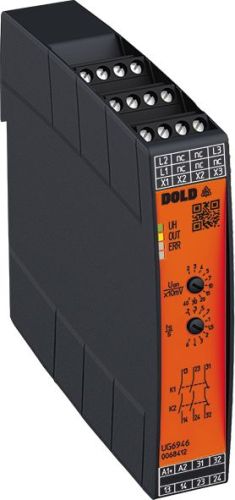
Dold 0068411 standstill monitor UH=DC24V
| Lieske Part No. | 1002234 |
|---|---|
| Mfg Part No | 0068411 |
| EAN-Code | 4030641684112 |
| Manufacturer | Dold |
| Here only | 625,20 EUR
743,99 EUR incl. VAT
|
Further information for Dold 0068411 standstill monitor UH=DC24V
| Technical data | |
| 1- / 2-channel | 2 |
| Cat. / PL acc. to EN ISO 13849-1 | 4/e |
| Classification | Sensorless |
| Forcibly guided output contacts max. | 1 NC contact, 2 NO contacts |
| Measuring motor voltage max. | 690 V |
| Nominal voltage | DC |
| SIL CL acc. to IEC/EN 62061 | 3 |
| SIL acc. to IEC/EN 62061 | 3 |
| Thermal current Ith max. | 5 A |
| Width | 22,5 mm |
| Type | UG 6946 |
| Variant | |
| Auxiliary voltage | DC 24 V |
| Contact equipping | 2 NO contacts, 1 NC contact (internal NC contacts switched in series) |
| Response value | 0,2 - 4 V |
| Terminal type | plug in screw terminal |
| Time range | 0,2 - 6 s |
| Approvals and Markings | UL-listed C/US, TÜV, UKCA |
| Variant | With muting |
Applications
The standstill monitor UG6946 is designed for use in safety-critical systems, particularly in manufacturing and packaging industries, on machines with moving parts, or in systems that must be certified according to EN ISO 13849-1 and IEC/EN 62061 standards. It is suitable for motors with a maximum measurement voltage of 690 V and can also be used in systems with frequency converters. The direction-independent operation allows use regardless of motor rotation direction, simplifying installation.
Functions and Equipment in Detail
The device features fail-safe safety output contacts: two normally open (NO) contacts for AC 250 V and one normally closed (NC) contact for DC 24 V, with the internal NC contacts connected in series. The trigger voltage is adjustable in the range of 0.2 to 4 V, and the standstill time can be set between 0.2 and 6 seconds. Adjustments are made via rotary switches, protected against unauthorized changes by a tamper-proof transparent cover. LED indicators signal the operating status, motor standstill, and a wire break in the measurement circuit.
Technology Explained Simply
The standstill monitor operates without external sensors by measuring the induced voltage in the motor during deceleration. When this voltage falls below the set threshold, standstill is detected. The auxiliary voltage is DC 24 V, required for the device’s own power supply. The maximum thermal current rating (Ith) is 5 A. The device connections consist of plug-in screw terminals, enabling secure and easy connections.
Compatibility and Accessories
The UG6946 can be combined with the safety interlock SAFEMASTER STS to realize additional protection functions. The variant UG6946.02PS/001/61 includes the option for standstill monitoring bypass (muting), which may be required for certain operating sequences. Certifications include UL-listed C/US, TÜV, and UKCA, enabling use in various markets.
Mounting and Installation
The device is mounted in an enclosure, with the width of 22.5 mm allowing for compact placement. Connections are made via plug-in screw terminals. Commissioning requires setting the trigger voltage and standstill time according to the system requirements. The operating instructions in the datasheet provide further guidance for correct installation and configuration.
Advantages in Operation
The sensorless technology eliminates the need for additional sensors such as encoders or proximity switches, simplifying installation and reducing maintenance. The fast response time and direction-independent operation increase reliability. Compatibility with safety interlocks and the muting function expand application possibilities. Certifications according to EN ISO 13849-1 (Category 4, PL e) and IEC/EN 62061 (SIL 3) ensure compliance with safety requirements in critical applications.

This is an offer of:
79279 Vörstetten
https://industry-electronics.com
Tel. 07666/88499-0
Fax. 07666/88499-111
Diesen Artikel finden Sie unter:
industry-electronics.com/artikel/1002234

Lieske Elektronik e.K.
Reutener Str. 1079279 Vörstetten
https://industry-electronics.com
Tel. 07666/88499-0
Fax. 07666/88499-111
Diesen Artikel finden Sie unter:
industry-electronics.com/artikel/1002234