
Dold 0068303 RR5887.12 AC/DC24-80V insulation fault detector
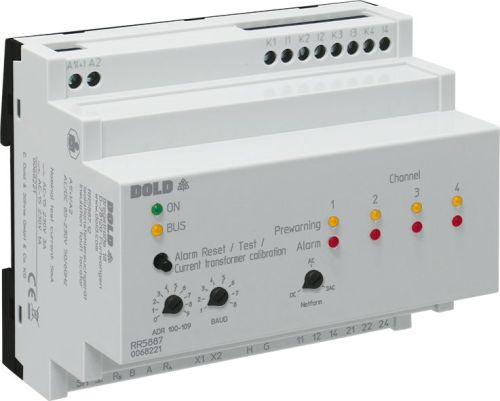
Dold 0068303 RR5887.12 AC/DC24-80V insulation fault detector
| Lieske Part No. | 1001641 |
|---|---|
| Mfg Part No | 0068303 |
| EAN-Code | 4030641683030 |
| Manufacturer | Dold |
| Here only | 462,96 EUR
550,92 EUR incl. VAT
|
Further information for Dold 0068303 RR5887.12 AC/DC24-80V insulation fault detector
| Technical data | |
| Bus interface | Modbus RTU, RS-485 |
| Nominal voltage IT system | DC, AC, 3AC 24 - 455 V |
| Operating mode | Slave |
| Width | 105 mm |
| Type | RR 5887 |
| Failure storage | |
| Variant | |
| Auxiliary voltage | AC/DC 24 - 80 V |
| Contact equipping | 2 changeover contacts |
| Variant | For industrial plants. 4 measuring channels |
Applications
The device is used for continuous monitoring of IT systems with nominal voltages of DC, AC, and 3AC in the range of 24 to 455 V. It is particularly suitable for installations where interruption of power supply is not acceptable, such as in production facilities, medical facilities, or marine systems. The ability to locate insulation faults in AC/DC networks makes it an important tool for preventive maintenance and ensuring network integrity.
Functions and Equipment in Detail
The insulation fault detection device features four measurement channels, to which external current transformers can be connected. These operate independently and are calibrated by the device to ensure precise measurement of fault currents. Indication is provided via LED indicators: yellow LEDs signal a warning when fault current exceeds 1 mA, red LEDs indicate an alarm when fault current exceeds 5 mA per channel. An additional yellow BUS-LED indicates activity of the RS-485 bus connection. The device operates in slave mode, meaning it works synchronously within a network of multiple devices via RS-485 bus connection.
Technology Explained Simply
The functionality is based on evaluating test currents impressed by the RR 5886 generator. The RR5887.12 analyzes the currents measured by the connected current transformers and detects deviations indicating insulation faults. Evaluation is carried out according to standards DIN EN 61557-9 (VDE 0413-9):2009 and DIN EN 61557-1 (VDE 0413-1), which apply to insulation fault detection in electrical installations. Insulation coordination follows IEC 60664-1, ensuring safety and reliability of the device in various network configurations. The auxiliary voltage can range from AC/DC 24 to 80 V, enabling universal adaptation to different power supply networks.
Compatibility and Accessories
The device is specifically designed for use with the test current generator RR 5886. Communication takes place via an RS-485 bus connection, which can optionally also be used for Modbus RTU fieldbus connection. The number of measurement channels can be expanded by linking multiple RR5887 devices via the bus, thereby improving fault localization accuracy in extensive networks. Status output is provided via an external switching output (terminals G, H) and two alarm relays (changeover contacts) for warning (terminals 11, 12, 14) and alarm (terminals 21, 22, 24). A push-button allows manual resetting of alarm states and testing of current transformers and their calibration.
Mounting and Installation
The device is housed in a standard industrial housing with a width of 105 mm, making it suitable for mounting in DIN-format enclosures. The connection terminals are clearly labeled: A1 and A2 for auxiliary voltage, K1 to K4/I1 to I4 for current transformers, SH, GND, Rb, B, A, Ra for RS-485 bus connection, X1 and X2 for switching input to alarm memory, and G, H for status output. The alarm memory function can be set via bridge X1-X2, with the input being active-low. Galvanic isolation of the RS-485 bus connection increases electromagnetic interference immunity and system safety.
Operational Advantages
Early detection and localization of insulation faults enable targeted and rapid correction, increasing the operational safety and availability of the power network. Simple operation through clear adjustment elements and automatic calibration reduces error susceptibility during commissioning and maintenance. Fault memory and the ability to output alarm states via external relays support integration into existing monitoring systems. The universal auxiliary voltage range of AC/DC 24 to 80 V increases flexibility during installation in various plant configurations.

This is an offer of:
79279 Vörstetten
https://industry-electronics.com
Tel. 07666/88499-0
Fax. 07666/88499-111
Diesen Artikel finden Sie unter:
industry-electronics.com/artikel/1001641

Lieske Elektronik e.K.
Reutener Str. 1079279 Vörstetten
https://industry-electronics.com
Tel. 07666/88499-0
Fax. 07666/88499-111
Diesen Artikel finden Sie unter:
industry-electronics.com/artikel/1001641