
Dold 0068222 RR5887.12/001 AC/DC85-230V insulation fault detector
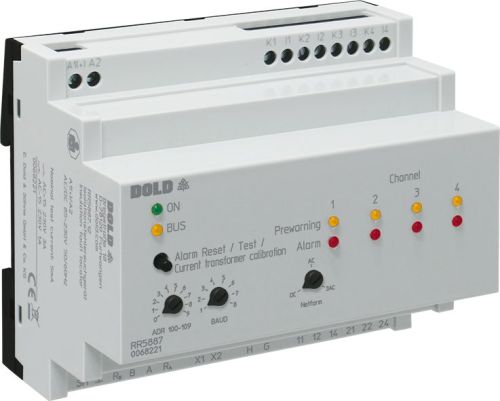
Dold 0068222 RR5887.12/001 AC/DC85-230V insulation fault detector
| Lieske Part No. | 1001645 |
|---|---|
| Mfg Part No | 0068222 |
| EAN-Code | 4030641682224 |
| Manufacturer | Dold |
| Here only | 827,77 EUR
985,05 EUR incl. VAT
|
Further information for Dold 0068222 RR5887.12/001 AC/DC85-230V insulation fault detector
| Technical data | |
| Bus interface | Modbus RTU, RS-485 |
| Nominal voltage IT system | DC, AC, 3AC 24 - 455 V |
| Operating mode | Slave |
| Width | 105 mm |
| Type | RR 5887 |
| Failure storage | |
| Variant | |
| Auxiliary voltage | AC/DC 85 - 230 V |
| Contact equipping | 2 changeover contacts |
| Variant | For industrial plants. 8 measuring channels |
Applications
This device is used for continuous monitoring of IT systems with nominal voltages in DC, AC, and 3AC ranges from 24 to 455 V. It is particularly suitable for installations where interruption of power supply is not acceptable, such as in production facilities, medical facilities, or marine systems. The ability to locate insulation faults in AC/DC networks makes it a central component of electrical safety technology in modern industrial environments.
Functions and Equipment in Detail
The insulation fault detection device features 8 measurement channels, each connected to external current transformers. These operate independently and are calibrated by the device to ensure precise fault localization. Indication is provided via LED indicators: yellow LEDs signal a warning when insulation fault current exceeds 1 mA, red LEDs indicate an alarm when fault current exceeds 5 mA. An additional yellow BUS-LED indicates activity of the RS-485 bus connection. The device operates as a slave, meaning it works synchronously in a network of multiple devices via RS-485 bus connection, increasing the number of measurement channels and refining fault localization in extensive networks.
Technology Explained Simply
The device operates according to standards DIN EN 61557-9 (VDE 0413-9):2009 and DIN EN 61557-1 (VDE 0413-1) and is designed for insulation coordination according to IEC 60664-1. The auxiliary voltage is AC/DC 85 to 230 V, enabling universal adaptation to various power supply networks. Fault memory is activated and can be set via bridge X1-X2. A switching input (terminals X1, X2) enables external control of the alarm memory function, with the input being active-low. Status output is provided via an external switching output, and two alarm relays (each with a changeover contact) indicate warning and alarm states. A push-button is used for manual reset of alarms, as well as for testing and calibration of current transformers.
Compatibility and Accessories
The device is specifically designed for use with the test current generator RR 5886. Communication takes place via an RS-485 bus connection, which can optionally also be used as a Modbus RTU fieldbus connection. The width is 105 mm, allowing installation in standard control panels. The connection terminals are designed for connection to current transformers, auxiliary voltage, RS-485 bus, and switching outputs. Devices can be networked to increase the number of measurement channels.
Mounting and Installation
Mounting is carried out in standard control panels with a width of 105 mm. Connections are made via terminals for auxiliary voltage (A1, A2), current transformers (K1–K4/I1–I4), RS-485 bus (SH, GND, Rb, B, A, Ra), switching input (X1, X2), and switching output (G, H). External current transformers are connected to the measurement channels and calibrated by the device. Configuration is performed using the control elements on the device, with the automatic adjustment function simplifying setup.
Operational Advantages
Early detection and localization of insulation faults enable targeted and rapid fault correction, increasing operational safety. Simple operation via clear adjustment elements and automatic calibration reduces user errors. Fault memory and the ability to output alarm states via external relays support process monitoring. Universal auxiliary voltage and Modbus RTU compatibility facilitate integration into existing automation systems. Use in combination with multiple devices via RS-485 extends functionality for large, complex networks.

This is an offer of:
79279 Vörstetten
https://industry-electronics.com
Tel. 07666/88499-0
Fax. 07666/88499-111
Diesen Artikel finden Sie unter:
industry-electronics.com/artikel/1001645

Lieske Elektronik e.K.
Reutener Str. 1079279 Vörstetten
https://industry-electronics.com
Tel. 07666/88499-0
Fax. 07666/88499-111
Diesen Artikel finden Sie unter:
industry-electronics.com/artikel/1001645